When we met at the Umtamvuna offices two weeks back we noticed that the firebreak and a block burn had been done on the grassland section of the Umtamvuna Nature Reserve near Blencathra and we thought that, having had a little rain since the burn, it might be worth exploring. We set off on foot from the offices. At this time of the year the grassland is usually pretty dormant but it was not long before we found Exochaenium grande half obscured in the grass. As we got closer to the wetland area adjacent to the first stream we found Disa polygonoides and a small group of Disa tripetaloides.
 |
| Exochaenium grande |
 |
| Disa polygonoides |
 |
| Disa tripetaloides |
In the drier areas we saw Eriosema parviflorum and the first bud of the season on a Pelargonium luridum.
 |
| Eriosema parviflorum |
 |
| Pelargonium luridum buds |
Also close to the stream were a few Psoralea latifolia with their blue flowers. Once we reached the burned areas we could see that we were too early to find many plants flowering. There were however several Gerbera natalensis with their very hairy stalks and many Cyrtanthus breviflorus that had responded to the post-fire conditions.
Shortly after we crossed the stream we saw some antelope grazing at the edge of the burn in the distance. At first we thought it was the same pair of Red Hartebeest that had found their way into the reserve some years back - we thought these were two of the same sex as they had failed to reproduce over the years. However on this occasion we noticed a smaller antelope with them and decided they had finally settled down to produce some offspring. However, looking at the photos in more detail later, it was apparent that the third animal was a Blesbok - probably another refugee from a nearby game farm.
 |
| Two red hartebeest with a blesbok (centre) |
 |
| Psoralea latifolia |
 |
| Gerbera natalensis |
 |
| Cyrtanthus breviflorus |
There were also some Callilepis laureola flowering at the edge of the firebreak. We had reached the end of the burned sections. On the rocks nearby we found Osterospermum imbricatum and Gnidia woodii and then we walked over and had a look at the forest growing along the edge of the gorge.
 |
| Callilepis laureola |
 |
| Osteospermum imbricatum |
 |
| Gnidia woodii |
At the forest edge the first thing to catch our attention was Alberta magna in flower - in the picture below being visited by a female Large Vagrant butterfly - ID kindly provided by our resident butterfly specialist, Alex. Adjacent to this was a cluster of Clutia pulchra. We were able to identify many other tree species in the forest below us but no others were in flower.
 |
| Alberta magna with Nepheronia argia subsp. varia |
 |
| Alberta magna |
 |
| Clutia pulchra |
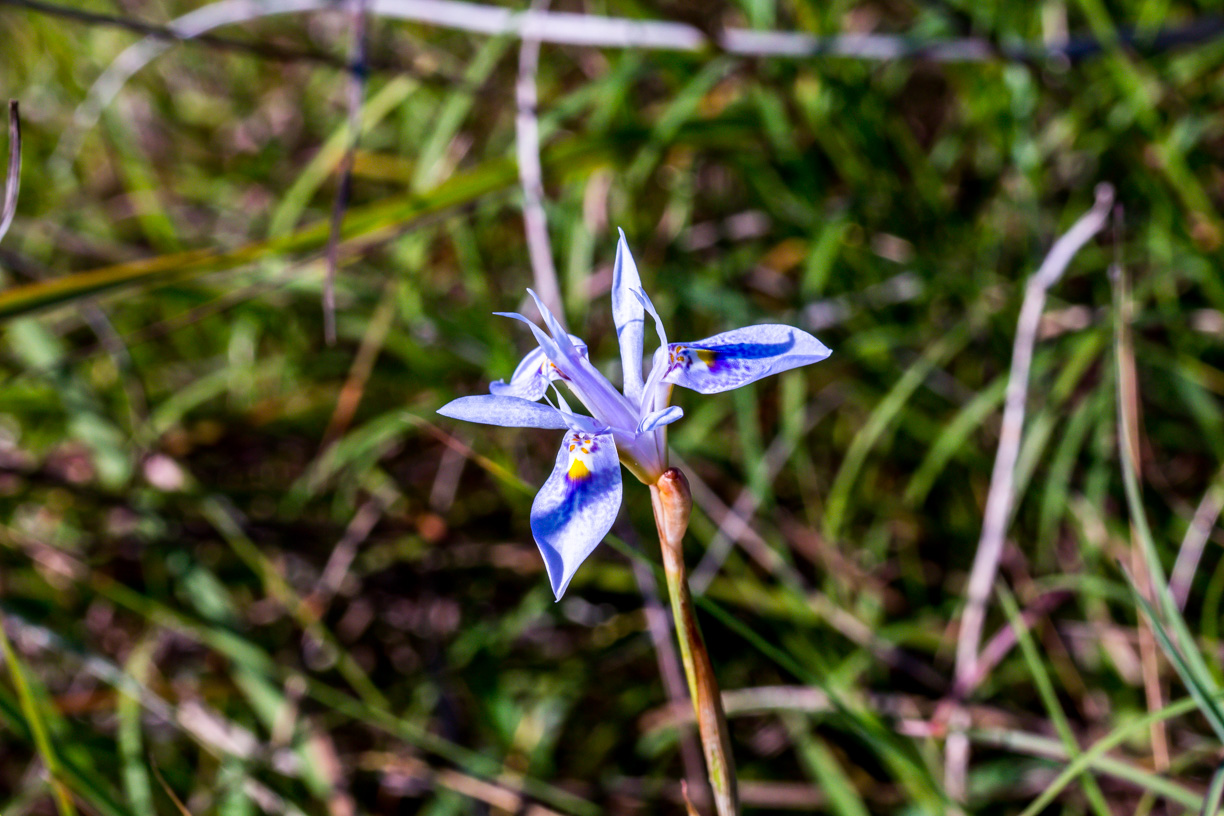
We chose a spot with a good view down into the Umtamvuna River gorge at the confluence with the Bulolo River and had lunch before returning along a different route. This took us past a large group of Morella serrata in flower and then a little later we started seeing Moraea elliottii flowers - an afternoon-flowering species.
 |
| The confluence of the Bulolo and Umtamvuna rivers |
 |
| Heading back up the side of the Bulolo River gorge |
 |
| Morella serrata |
 |
| Moraea elliottii |
Participants: Anne S, Colin T, Dorothy M, Gail B-W, Graham G, Kate G, Maggie A, Mark G, Tracy T.