The weather was perfect for botanising. The sun was gentle and there
was no breeze to blur photos.
We made our way to Cascades in Western Heights in the Umtamvuna Nature Reserve. The
fence had collapsed through vandalism and neglect and free-range resident cattle
now lived and roamed with a platter of flowers to eat. Plants that are vulnerable are even more so now that these beasts
are not been moved off the reserve.
We found Lotononis bachmanniana, Eulophia parviflora flowering and on
the slopes the fiery Erica cerinthiodes caught our eye and took our breath away
in its coral magnificence.
 |
Lotononis bachmanniana
FABACEAE
Near Threatened A4c; B1ab(iii)+2ab(iii)
South African endemic
|
 |
Eulophia parviflora
ORCHIDACEAE
 | | Tracy and Dorothy enjoying the spectacular Fire Heath. |
|
 |
Erica cerinthoides
ERICACEAE
|
 |
Searching for specials.
|
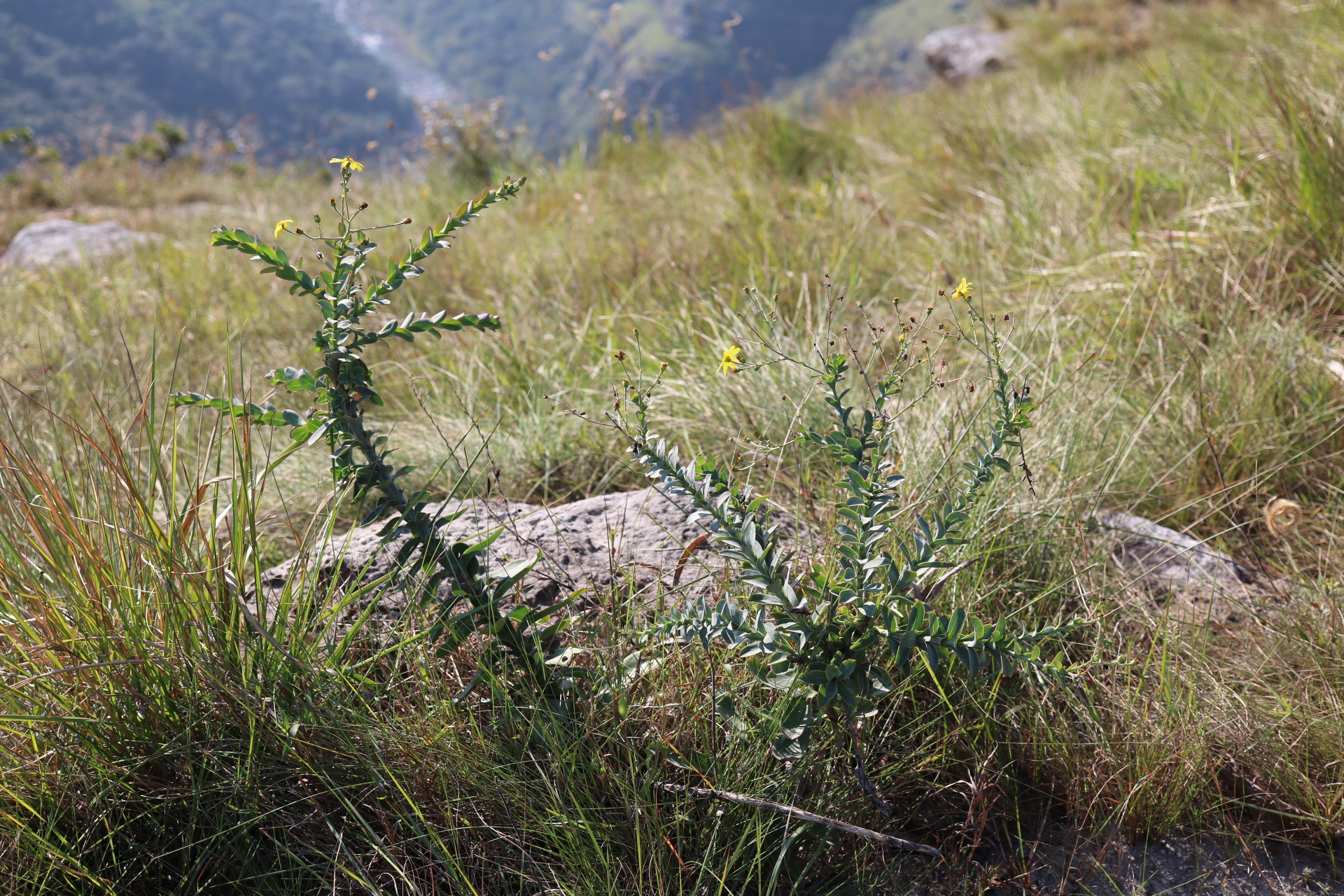
To our delight we found Disparago tortilis.
We don’t come across this often. What a beautiful flower! Disparago tortilis is threatened by habitat degradation, habitat loss, harvesting and
invasive alien species. This a resilient shrub with fine winding branches and
needle-like leaves. It can grow in arid and harsh environments.
 |
 | Disparago tortilis
ASTERACEAE
South African endemic
 | Botanising in Western Heights near Cascades.
|
|
|
One Watsonia pillansii was in flower.
 |
Watsonia pillansii
IRIDACEAE
South African endemic
|
Two varieties of Psolarea were found where a beautiful Reedbuck was seen bounding off to seek safety from human-kind.
 |
Psoralea arborea
FABACEAE
 | Psoralea glabra
FABACEAE
|
|
Nuxia floribunda was on show, it crown a show of ivory
flowers, it truly is quite a sight and can be seen throughout the forest in its
contract to the trees that are all green. What is not to be loved about
this tree! It’s a gardener’s
delight. It’s fast growing, wind
tolerant, showy, scented, ornamental, it can be grown in a pot, used as screen,
looses minimal leaves, grows in heavy clay soils, you can grow it in small
gardens and birds love it. Its children
friendly and gives you lovely shade.
 |
Nuxia floribunda
STILBACEAE
|
In the grassland Exocaenium natalense was
prolific and Morea elliotii opened up to show its face around two
o'clock. Pseudopegolettia tenella grew close a steep embankment alongside
Asclepia praemorsa. It truly does take a trained eye to see some
plants.
 |
Exochaenium natalense
GENTIANACEAE
 | Moraea elliotii
IRIDACEAE

|
 | Pseudopegolettia tenella
ASTERACEAE
|
|
On the rocks one could find Crassula
sarmentossa var integrifolia, Delosperma subpetiolatum, Crassula perforata subsp. perforata, Cotyledon orbiculata var. orbiculata
and Caputia medley-woodii. Rocks always have interesting things
growing on them. They are islands of flowering gems.
 |
Delosperma subpetiolatum
AIZOACEAE
Vulnerable B1ab(ii,iii)+2ab(ii,iii)
South African endemic
|
|
 |
Cotyledon orbiculata var. orbiculata
CRASSULACEAE
|
 |
Caputia medley-woodii
ASTERACEAE
|
 |
Crassula sarmentosa var. integrifolia
CRASSULACEAE
South African endemic
Rare
 | Crassula perforata subsp. perforata
CRASSULACEAE
South African endemic
 | Photo credit: Tracy
Gail watching the vultures and looking at the beautiful Mtamvuna River below.
|
 | Helichrysum herbaceum
ASTERACEAE

 | Asclepias praemorsa
APOCYNACEAE

|
 | Osteospermum imbricatum
ASTERACEAE
|
|
|
|
The sticky fruits of Agelanthus natalitius were
found on a tree waiting for birds to go place them onto another host. This is
a parasitic plant which is a tree parasite, it's also known as a
mistletoe. Birds are attracted to the fruit,
they split the skin to get at the very sticky seed covering called 'viscin'
(from which 'bird lime' can be made). The sticky seed is rubbed off on nearby
branches and thus dispersed. Tree parasites can cause some of the outer
branches of trees to 'starve' and die off but it is not a good idea to try and
remove the parasites. It will just cause more damage to the host tree. The
parasites are interesting plants in their own right and will produce colour and
attract birds in the dry season.
 |
Agelanthus natalitius
LORANTHACEAE
|
We found Garcinia gerrardii growing in the baking sun on a
cliff's edge. This is a tree that one finds in a forest. and is known commonly
as a Forest Mangosteen.
 |
Garcinia gerrardii
CLUSIACEAE
|
 |
Cape Vultures
|
 |
| Approximately 50 CapeVultures soaring in the sky. |
Tricalysia capensis var. capensis was in full flower and the air was heavily and heavenly scented.  |
Tricalysia capensis var. capensis
RUBIACEAE
|
 |
Pondoland C.R.E.W./Thursday Group
Maggie, Gail, Ushi, Dorothy, Hilliary, Tracy, Buyi and Anne |
"Wind moving through grass so that the grass quivers. This moves me with an emotion I don't even understand. "
Katherine Mansfield.