Kate and I made an early start heading for Ntsikeni Nature Reserve to participate in a bioblitz organised by UKZN - in an effort to document the biodiversity in the reserve more comprehensively. After bouncing up the forestry roads we arrived at the reserve gate and were soon appreciating the natural beauty around us, like the wispy pink grass. We then headed to the first stream crossing to see what orchids were growing in the wetland. All the
Disa scullyi had finished flowering but there were a few
Habenaria schimperiana and a single
Habenaria lithophila, plus some scattered
Satyrium longicauda.
On the nearby rocky slope we found a few
Asclepias vicaria still flowering and several
Disa versicolor.
 |
| Kate collecting a specimen of the pink grass |
 |
| Habenaria schimperiana |
 |
| Asclepias vicaria |
 |
| Disa versicolor |
We headed on to the lodge where we met up with many of the other participants in the bioblitz. Timo van der Niet, Ruth Cozien and Steve Johnson joined us as we headed up towards the saddle near Ntsikeni peak. On the way we chanced on an unusual yellow form of
Eulophia ovalis and on the boulder strewn ridge we found a few
Gladiolus oppositiflorus.
 |
| Eulophia ovalis |
 |
| Gladiolus oppositiflorus |
Higher on the slope we came across numbers of
Berkheya multijuga bearing old flower heads and a very sticky leafed
Melolobium alpinum. Scattered around the grassland were several
Brunsvigia grandiflora, Protea dracomontana and the odd tall
Moraea triffida. Sheltering among the boulders were
Plectranthus grallatus, Satyrium parviflorum, Wahlenbergia huttonii and
Schizoglossum bidens.
 |
| Berkheya multijuga |
 |
| Melolobium alpinum |
 |
| Moraea triffida |
 |
| Plectranthus grallatus |
 |
| Protea dracomontana |
 |
| Schizoglossum bidens |
 |
| Satyrium parviflorum |
 |
| Wahlenbergia huttonii |
A notable feature of these grasslands was the display of
Zaluzianskya microsiphon with their striking white flowers edged with red or salmon pink. We reached the plateau and the others pushed on to scale the heights of Nsikeni peak. Just as we set off across the relatively flat plateau we came across a
Xysmalobium rhodanthum still flowering.
 |
| Zaluzianskya microsiphon |
 |
| Xysmalobium rhodanthum |
 |
| On Ntsikeni's plateau |
As we crossed these grasslands we found a small yellow orchid - clearly a
Schizochilus but the flowers were way too small to be
S. zeyheri that we know from the coast. On subsequent discussion with Benny Bytebier, this turned out to be the Rare
Schizochilus bulbinella. We were to see many more of this species later during the trip. At this altitude we found several
Helichrysum cooper, and while fossicking around the boulders on the edge of the plateau we were surprised to find a few
Kniphofia caulescens, one of which was about to flower.
Other plants found on the plateau were Xysmalobium tysonianum, Satyrium macrophila, and Polemannia montana. On the way back down we found a fruit on a Xysmalobium stokenstroomense and in between some dolerite boulders we found a Kniphofia linearifolia.
 |
| Helichrysum cooperii |
 |
| Kniphofia caulescens |
 |
| Kniphofia linearifolia |
 |
| Satyrium macrophila |
 |
| Polemannia montana |
 |
| Xysmalobium stokenstroomense |
We elected to descend via a second dolerite ridge as these seemed to be particularly species rich. Far below us we could see the vehicles of the bioblitzers clustered around Ntsikeni lodge. At the bottom of the ridge we found
Sopubia cana and as we followed the stream back towards our vehicle, we found large clusters of
Crocosmia paniculata growing near the stream, in places together with a backdrop of the blue of
Agapanthus flowers.
That was a full enough day for us so we headed off to our accommodation at Flitwick Ranch near Swartberg.
 |
| An appropriate place for meditation |
 |
| The lodge overrun by bioblitzers |
 |
| Sopubia cana |
 |
| Crocosmia paniculata |
The next morning after breakfast we drove back to the reserve, stopping to photograph a roadside
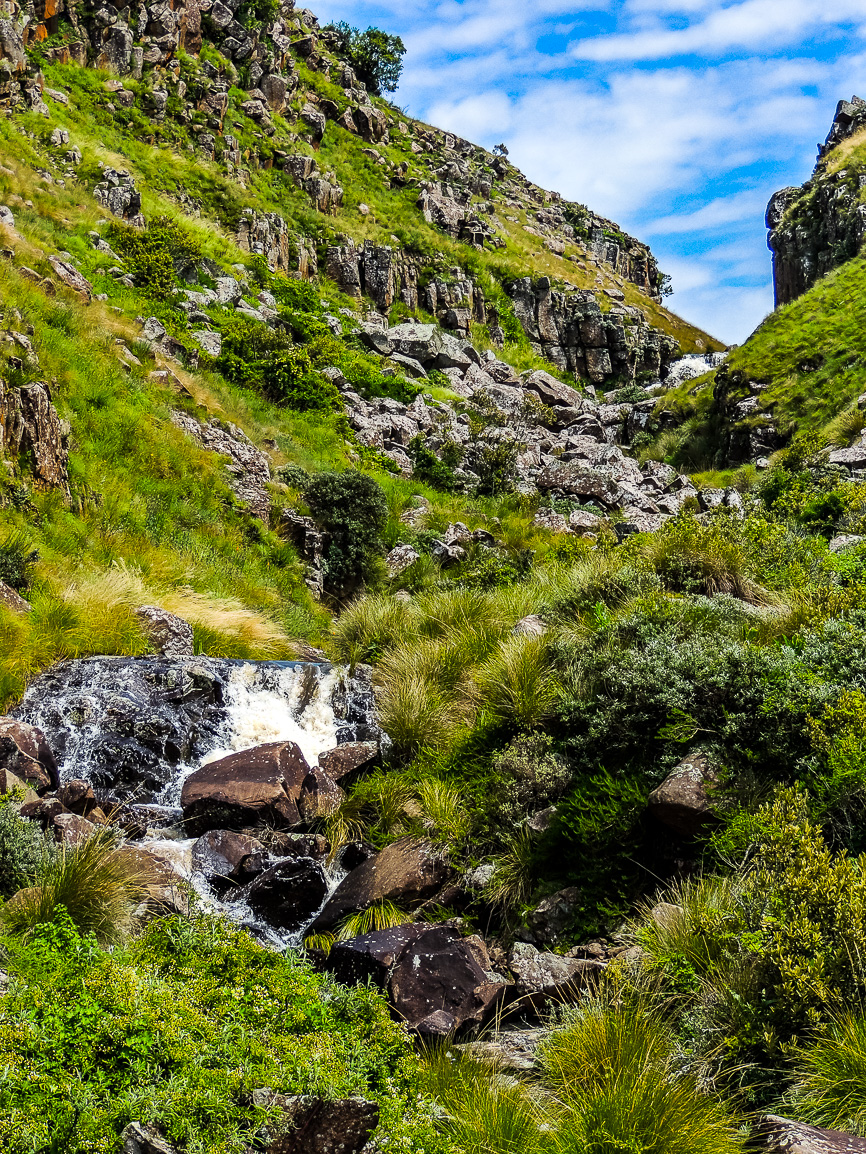
Pterogodium magnum. Once in the reserve, together with Benny Bytebier and Alison Young, we stopped at the big bridge and headed downstream, with the intention of exploring the next stream up a narrow gorge in an attempt to get to a waterfall that we had seen from a distance.
 |
| Pterygodium magnum |
 |
| Ntsikeni stream draining the northern wetland |
Just after leaving the road we encountered a patch of a few score of
Schizochilus bulbinella, more robust than many of those seen the previous day. Near to these we found some
Disa brevicornis. A little further downstream where the valley narrowed a little, we found some bright red
Satyrium hallackii, Wahlenbergia rivularis and a single
Watsonia gladioloides. Growing in the stream was a
Peltocalathos baurii. On the slopes away from the stream there were several robust
Crassula acinaciformis.
 |
| Schiozochilus bulbinella |
 |
| Disa brevicornis |
 |
| A bright red Satyrium hallackii |
 |
| Wahlenbergia rivularis |
 |
| Watsonia gladioloides |
 |
| Crassula acinaciformis |
 |
| Peltocalothos baurii |
In a shallow depression we found several very showy
Manulea florifera. As we dropped down to the second, more substantial stream, we found
Schizoglossum atropurpureum subsp. atropurpureum sporting its purple flowers at the ends of tall stalks.
 |
| Manulea florifera |
 |
| Schizoglossum atropurpureum subsp atropurpureum |
We reached the second stream and the going became more difficult, having to scramble over large boulders and through thick shrubbery. We found a patch of Coccinia hirtella draped over several boulders and next to this was a Papaver aculeata. Further up the gorge we found another Coccinia hirtella, this one bearing a number of red and green fruits.
In a rock crevice we found Streptocarpus pusilus and another blue-flowered Streptocarpus which we have yet to identify. At the streamside we found Satyrium cristatum. We managed to scramble up to the main waterfall, noting Eucomis comosa subsp. striata and Cyrtanthus epiphyticus growing in the spray zone. After this we scrambled our way up the near vertical slope to the peak above where we stopped for lunch. I was able to get a better perspective of the rest of the stream from the upper slopes.
 |
| Papaver aculeata |
 |
| Coccinia hirtella |
 |
| Streptocarpus pusilus |
 |
| Satyrium cristatum |
 |
| Enjoying the mountain stream |
 |
| The road ahead - boulder hopping required |
 |
| The top waterfall |
 |
| Climbing out of the gorge - a shoulder disappearing behind the rocks |
 |
| The stream above the falls |
 |
| Looking down the gorge |
We left Benny and Alison near the road where they wanted to collect more material, while we had a long drive home ahead of us. We stopped for a last look at a substantial population of
Disperis fanniniae Benny and Alison had found earlier growing under some invasive wattles - a spectacular sight to end two very enjoyable days at this very speciel reserve.
 |
| Disperis fanniniae |
Participants: Day 1: Graham G, Kate G, Ruth C, Steve J, Timo v d Niet
Day 2: Alison Y, Benny B, Graham G, Kate G.