Monday, 25 June 2018

Climbing "80 floors" in the hills around Ngwamabala (Thursday 21 June 2018)

Through a rather convoluted set of contacts we made arrangements to visit grasslands in the Ngwamabala area near Bushy Vales. Today Rachel joined us again for the first time after her first term at UCT and we met our guides for the day, Richard and Tanya Wichmann and Micha xxx near Southbroom. We set off in three vehicles on the steep and windy rural roads, eventually arriving where we were to meet the Induna and some of his councillors. We were grilled on what we wanted to achieve by visiting their area but our reception became much warmer when they learned that we were offering to help them by assessing their grasslands and forested areas, looking for special plants.

We then set out on foot accompanied by Nduna Mbita and his son Talende, heading down a steep slope past a couple of homesteads and eventually reaching the Mbizana River. On the way we encountered a Ceratotheca triloba and far below us were a few Aloe maculata flower heads poking out above the grass.   

Meeting with the Nduna and his council (Photo G B-W)


Ceratotheca triloba

Aloe maculata

Crossing the Mbizana River


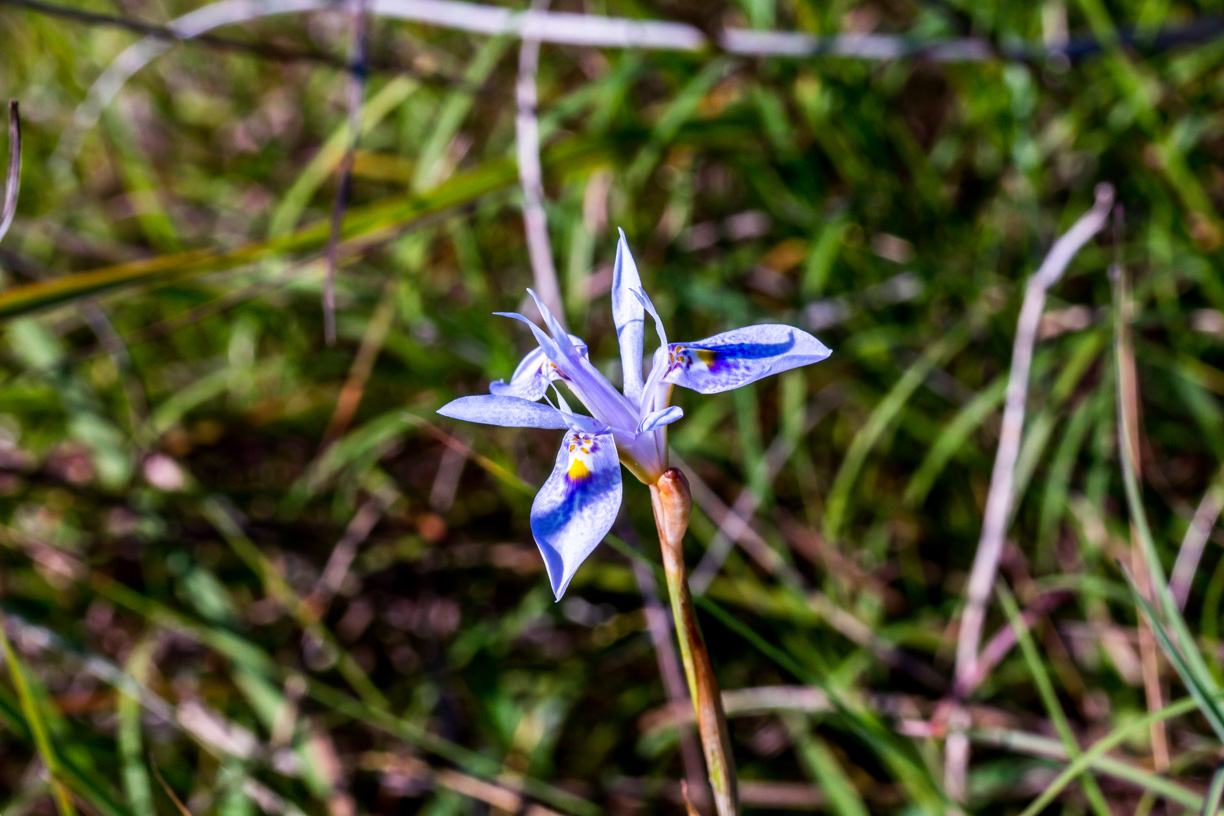
In the riverbed we saw a few Dietes grandiflora. Once across the river we had the opportunity to look at trees growing along the banks. We saw Albizia adianthifolia with many seed pods and a nearby Chaetacme aristata had many small orange fruits. We also found some Strychnos spinosa with their large round fruits. There were few forbs flowering in the grasslands here - both in the burned and unburned sections.

 
Dietes grandiflora


Albizia adianthifolia

Chaetacme aristata

Strychnos spinosa

We reached a spot where the banks of the river became a little steeper and found the first of many Aloe candelabrum sporting orange inflorescence spikes. We joined the Nduna and one of his councillors in the shade on the river bank and sat on rocks in the riverbed to have our lunch. After lunch we decided to walk back on the opposite bank of the valley and headed straight up the hill behind us.


Aloe candelabrum
This turned out  to be the equivalent of climbing 80 floors, according to Tanya's phone activity meter, before we finally reached the road. Thankfully, Tanya had gone on before us and returned to collect us in her vehicle. 

On the way up the hill we had seen some Erythrina lysistemon in full flower, an imposing sight against the clear blue sky. In a cluster of granite boulders, Tracy noticed an unusual looking leafless succulent tree with terminal clusters of small fruits. When we collected a specimen for later identification, we noticed copious milky latex. Alex subsequently looked up this plant and suggested it might be Synadenium cupulare, the deadman's tree, so named for its very toxic and corrosive latex. This plant has been renamed since our reference books were published and is now Euphorbia cupularis. It came out subsequently that Alex had eaten some of his lunchtime fruit after handling the shrub and had later experienced some mild symptoms of burning on his lips - a lucky escape!


Starting the climb out of the valley

Part way up the 80 floors


Gazania krebsiana

Lasiosiphon kraussianus 

Nduna Mbita (R) and a councillor (Photo G B-W)


Collecting the specimen of Synadenium cupulare

Erythrina lysistemon

Sida dregei
Finally we reached the top, very relieved to have a vehicle waiting for us. We left the Induna with a promise to return later in the year after rain for further exploration of the area.

Participants: Alex V, Anne S, Colin T, Dorothy M, Gail B-W, Graham G, Kate G, Mark G, Michel B, Nduna Maku M, Rachel B-W, Richard W. Talende M, Tanya W, Tracy T.

Monday, 18 June 2018

Walking the south-western part of the Western Heights grasslands (Thursday, 14 June 2018)

Today we had two people join us for the first time, Alison and Michel. We decided to travel to the Western Heights and find a part of the grassland that we have not explored before. We parked near the Proteas and set off walking westwards, dodging scores of Cyrtanthus breviflorus in the recently burned grassland on the way. The fire had also caused the Protea caffra to release its seeds making an interesting pattern on the burned ground.


Cyrtanthus breviflorus

Protea caffra seeds


We crossed over the burned section and dropped down to a stream. At the stream crossing we found Podalyria burchellii with both flowers and hairy seed pods. Alex noted a cluster of red flowers on the opposite slope and we went to investigate, finding a bright group of Erica cerinthoides. Walking back down towards the stream I found the first Disa baurii of the season.
Podalyria burchellii

Erica cerinthoides

Disa baurii

Back at the stream we found one of our target species for the year - Faurea macnaughtonii - and fortunately this specimen was still carrying old fruits. In this part of the streamside forest we also saw Putterlickya retrospinosa, Eugenia erythrophylla and Schefflera umbellifera as well as Syzygium gerrardii in fruit.


Faurea macnaughtonii

Eugenia erythrophylla

Schefflera umbellifera

Syzygium gerrardii

In a very accessible place we found a flowering Dermatobotrys saundersii carrying an old fruit, and later we saw another of this species also flowering and growing in a hollow high up in a tree.

Dermatobotrys saundersii

Although it was not a hot day, we still enjoyed the cool shade of the tall trees in the forest as we sat in the river bed having our lunch. Anne found an interesting plant that was subsequently identified as Trichocladus crinitus. After lunch we scrambled down the river bed until it became obvious the banks had become too steep for us to comfortably climb out, so we retraced our route to the junction with a side stream and clambered out there.


A riverine lunch spot

Trichocladus crinitus

We strolled back in the mellow late afternoon winter sunshine, finding a small cluster of Crassula perfoliata subsp heterotricha growing on a weathered rock on the way.


Walking homeward


Crassula perfoliata subsp. heterotricha

Participants: Alex V, Alison L, Anne S, Colin T, Gail B-W, Graham G, Kate G, Michel B, Tracy T.

Saturday, 9 June 2018

Exploring burned Umtamvuna firebreaks (Thursday 7 June 2018)

When we met at the Umtamvuna offices two weeks back we noticed that the firebreak and a block burn had been done on the grassland section of the Umtamvuna Nature Reserve near Blencathra and we thought that, having had a little rain since the burn, it might be worth exploring. We set off on foot from the offices. At this time of the year the grassland is usually pretty dormant but it was not long before we found Exochaenium grande half obscured in the grass. As we got closer to the wetland area adjacent to the first stream we found Disa polygonoides and a small group of Disa tripetaloides.

Exochaenium grande

Disa polygonoides

Disa tripetaloides

In the drier areas we saw Eriosema parviflorum and the first bud of the season on a Pelargonium luridum.


Eriosema parviflorum

Pelargonium luridum buds

Also close to the stream were a few Psoralea latifolia with their blue flowers. Once we reached the burned areas we could see that we were too early to find many plants flowering. There were however several Gerbera natalensis with their very hairy stalks and many Cyrtanthus breviflorus that had responded to the post-fire conditions.

Shortly after we crossed the stream we saw some antelope grazing at the edge of the burn in the distance. At first we thought it was the same pair of Red Hartebeest that had found their way into the reserve some years back - we thought these were two of the same sex as they had failed to reproduce over the years. However on this occasion we noticed a smaller antelope with them and decided they had finally settled down to produce some offspring. However, looking at the photos in more detail later, it was apparent that the third animal was a Blesbok - probably another refugee from a nearby game farm.


Two red hartebeest with a blesbok (centre)

Psoralea latifolia

Gerbera natalensis

Cyrtanthus breviflorus

There were also some Callilepis laureola flowering at the edge of the firebreak. We had reached the end of the burned sections. On the rocks nearby we found Osterospermum imbricatum and Gnidia woodii and then we walked over and had a look at the forest growing along the edge of the gorge.


Callilepis laureola

Osteospermum imbricatum 

Gnidia woodii

At the forest edge the first thing to catch our attention was Alberta magna in flower - in the picture below being visited by a female Large Vagrant butterfly - ID kindly provided by our resident butterfly specialist, Alex. Adjacent to this was a cluster of Clutia pulchra. We were able to identify many other tree species in the forest below us but no others were in flower.

Alberta magna with Nepheronia argia subsp. varia

Alberta magna

Clutia pulchra

We chose a spot with a good view down into the Umtamvuna River gorge at the confluence with the Bulolo River and had lunch before returning along a different route. This took us past a large group of Morella serrata in flower and then a little later we started seeing Moraea elliottii flowers - an afternoon-flowering species.


The confluence of the Bulolo and Umtamvuna rivers

Heading back up the side of the Bulolo River gorge

Morella serrata


Moraea elliottii
Participants: Anne S, Colin T, Dorothy M, Gail B-W, Graham G, Kate G, Maggie A, Mark G, Tracy T.