With Anne reaching the final stage of her convalescence and willing to attempt a longer walk than in the recent past, we decided to head to Foster's Folly to see what was flowering along the cliff edges and to explore the always interesting forest patch at the top of the knoll that leads to Foster's Folly. As we left the vehicles we were exposed to the amazing drop-offs that the cliffs form along this section of the Umtamvuna River gorge.
 |
| Looking down the Umtamvuna River gorge towards Foster's Folly |
 |
| Looking upstream at the Umtamvuna River gorge |
Following the cliffs we soon came to an area where a portion of the cliffs had tilted outwards but where the gap had filled in over the years - we could follow this gap down a short distance until the slope became too steep. Exposed at the top of the gap was Combretum kraussii showing its russet fruits.
 |
| Combretum kraussii fruits |
 |
| Exploring the gap |
Re-emerging from the gap we walked further until we had a good view of the edge of the gap from above. Here we saw two White-necked Ravens roosting on the krans.
 |
| Looking back at the sharp edge of the gap |
We moved further along enjoying the views. Emerging from under cliff-edge shrubs we saw many flowering Caputia medley-woodii.
 |
| Caputia medley-woodii |
There were many different species of orchids along the exposed edges here - terrestrial as well as epiphytic and lithophytic. In one place it was interesting to see a small clump of three species together, Bulbophyllum, Polystachya and Tridactyle, and close by there was an elongated new Bulbophyllum scaberulum shoot.
 |
| Exploratory shoot of Bulbophyllum scaberulum |
Climbing in one of the cliff-edge shrubs was a flowering Sarcostemma viminale. The Protea roupelliae were flowering along this section of the cliff top.
 |
| Protea roupelliae |
 |
| Sarcostemma viminale |
In a typical exposed location we found some Ypsilopus erectus in flower - this species often is found as an lithophyte on a south-facing vertical face over a substantial drop. Mark found out how life-threatening it can be getting a close-up view of the species - and nearly lost his hat over the cliff in the process.
 |
| Ypsilopus erectus |
 |
| Cliff hanging to get a closer look |
We then reached the forest patch at the top of Foster's Folly and were lucky enough to find one of our CREW target species here - Plectranthus ernstii.
 |
| Plectranthus ernstii |
In the protection of the forest was an amazing collection of different Lichen species - unnamed as we have yet to find a Lichen specialist who can give us guidance.
 |
| Lichens |
 |
| Lichen and closeup |
 |
| Lichen and closeup |
 |
| Lichen |
 |
| Lichens |
Anne found a still-flowering Brownleea coerulea in a cleft and sprawling in trees down the steep slope below us we saw Anisochaeta mikanioides full of flowers. In this forest patch we found Tarchonanthus trilobus in flower and Pterocelastrus echinatus bearing fruits.
 |
| Brownleea coerulea |
 |
| Anisochaeta mikanioides |
 |
| Tarchonanthus trilobus |
 |
| Pterocelastrus echinatus |
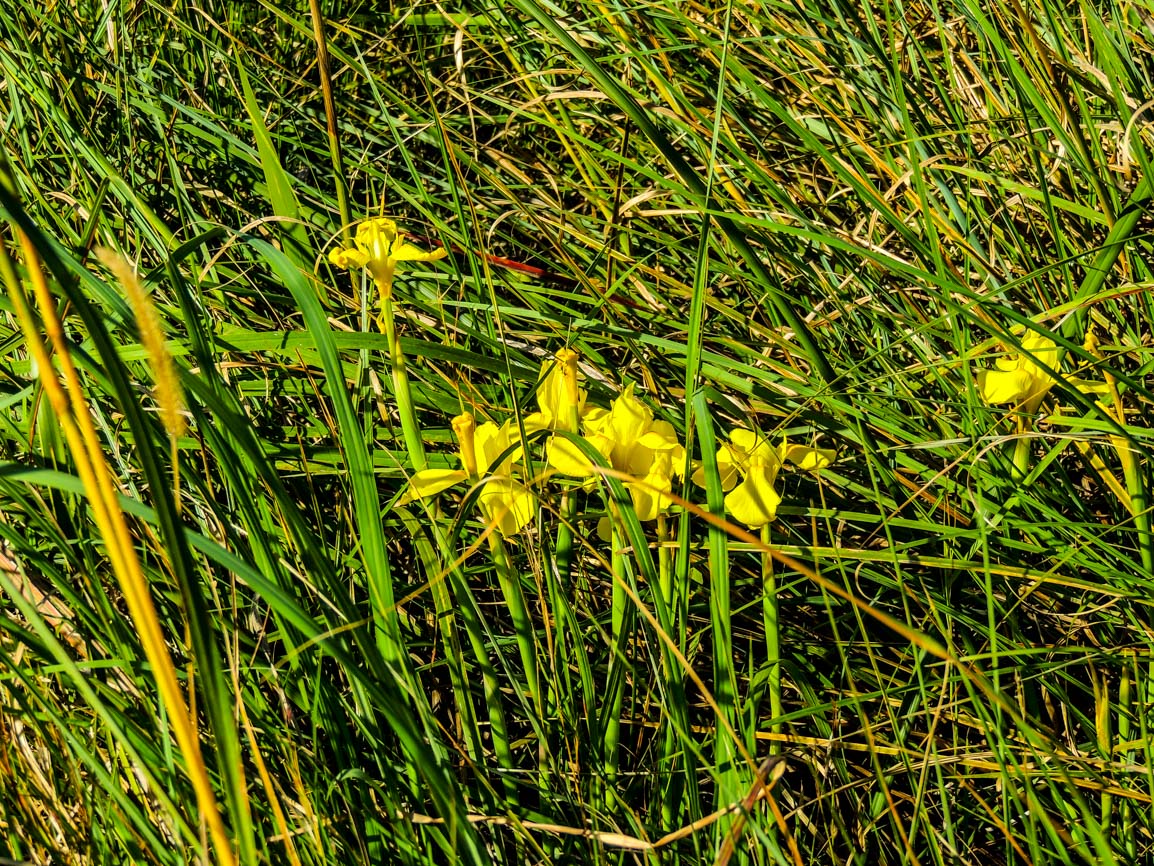
After enjoying lunch watched by a Crowned Eagle and lulled by the call of some Crowned Hornbills, we headed back a different way, coming across two Erica species in flower, Erica cerinthoides and Erica cubica, as well as a bright cluster of Moraea spathulata.
 |
| Erica cerinthoides |
 |
| Erica cubica |
 |
| Moraea spathulata |
Participants: Anne S, Colin T, Dorothy M, Elaine L, Gail B-W, Graham G, Kate G, Mark G.