Saturday, 21 October 2017

A gale-force trek to Anemone Falls (Thursday 19 October, 2017)

We set off to the Western Heights in a strong south-westerly wind, aiming to head for Anemone Falls to collect a specimen of the Vulnerable Anemone bracteata, as it has been some time since a specimen was last collected. This is a very popular traditional medicinal plant and has been heavily collected in unprotected areas, so it is important to keep track of the state of known populations.

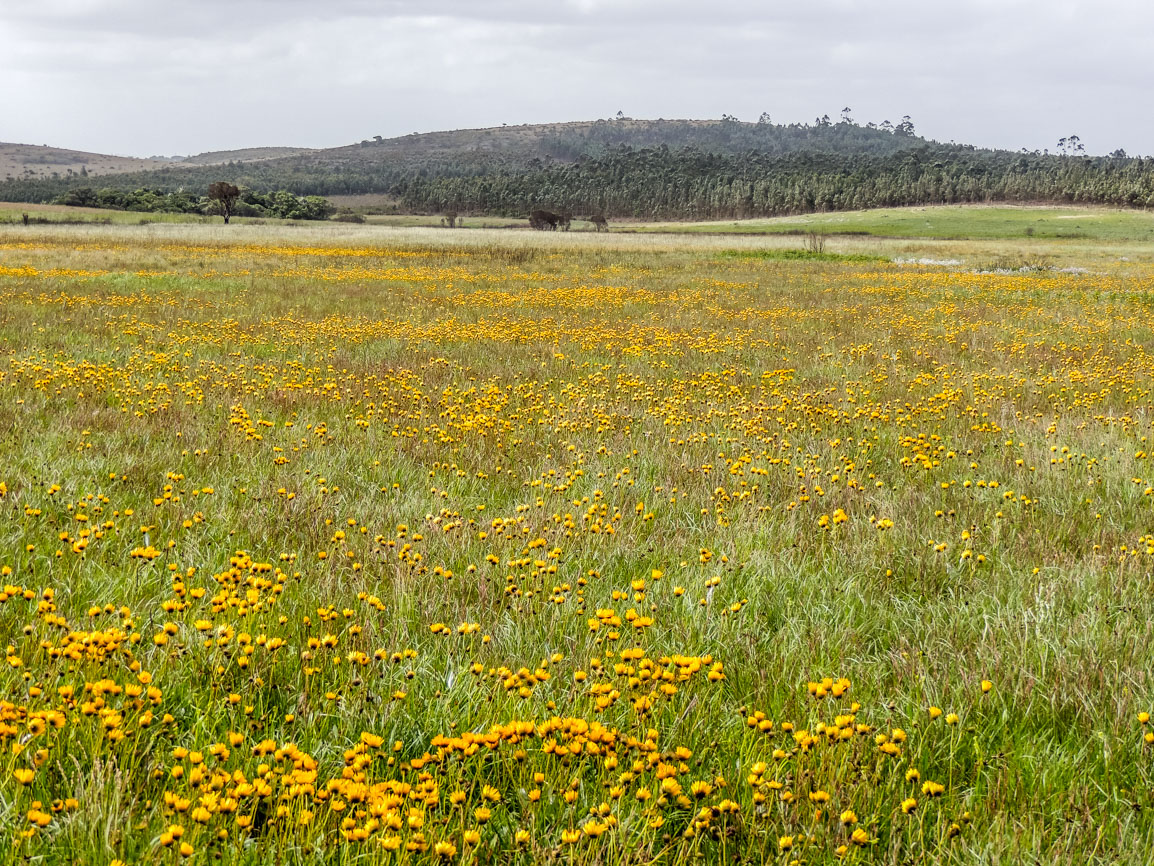
As we reached the gate of the reserve leading on to the Western Heights, a vista of white and yellow opened up before us, even more impressive than it had been on our previous visit three weeks ago. It is unfortunate that while the floral displays of the Western Cape are world-renown, few people, even those living in close proximity to reserves like Umtamvuna Nature Reserve, are aware that we have similarly impressive displays on our doorstep.


A panorama in white and yellow
We drove on along the track stopping frequently to take more photos. Bundled up against the cold wind, we set off into a valley in an attempt to get away from the full force of the wind. 

We collected material from a small Apodytes abbottii, another of our target species for new collections.
 
Apodytes abbottii


Alberta magna flowers caught the eye, as did a display of Acridocarpus natalitius adorning the top of the stream-side forest canopy. Amongst the more common trees in this strip of forest we saw Eugenia erythrophyllum, E. natalitia, Clutia sp. nov., Dahlgrenodendron natalense and Rhynchocalyx lawsonoides.

We followed the tree line for a while but then had to mount a small rise and brave the wind again before descending into the next valley, across a slope covered with sweet-smelling flowering Leucadendron spissifolium subsp. oribinum. This was another of our target species so we were doing better than expected.


A slope covered in flowering Leucadendron spissifolium subsp. oribinum shrubs
We walked along the forest straddling the stream leading to Anemone Falls and this time we found a less precarious way into the stream bed than climbing down to the lip of the falls and walking upstream - particularly so today as the strong wind was blowing the waterfall back into the forest.

As we reached the stream we came across the first of the Anemone brevistylis plants and we were delighted to see that they were flowering. Unfoirtunately we were later to find out this is the much more common Anemone brevistylis. Alongside these on a steep bank in deep shade was a cluster of the Rare endemic Crassula streyi. Overhanging the Anemone was another Rare endemic, Rinorea domatiosa in flower. It was very rewarding to find so many special plants in a small area.


Anemone brevistylis

Anemone brevistylis

Rinorea domatiosa

Looking down Anemone Falls

Anemone Falls
We had our lunch a short distance upstream from the falls to get away from the spray.  Our return trip was aided by the strong wind at our backs. At the edge of the forest we found several Harveya pauciflora in bud.


Harveya pauciflora

We made our way through another small forest patch to check on a population of Clivia robusta (no flowers) and came across an Excoecaria simii in fruit. Then on up the slope encountering Watsonia densiflora on the exposed slope and a single Disa saggitalis secreted in a small south-east facing rock outcrop.


Disa saggitalis
 
Watsonia densiflora


Wind-blown near Anemone Falls
For much of the day we had been walking through rather tall, unburned grassland, so on the way back we decided to treat ourselves with a brief stop in the burned section we had seen from the gate. Apart from the eye-catching feast of Berkheya speciosa with a wash of white Helichrysum ecklonis in the background, there were many other flowers hidden away, such as Leobordea pulchra, Sopubia simplex, Satyrium longicauda and the odd Lotononis bachmanniana.

A feast of flowers

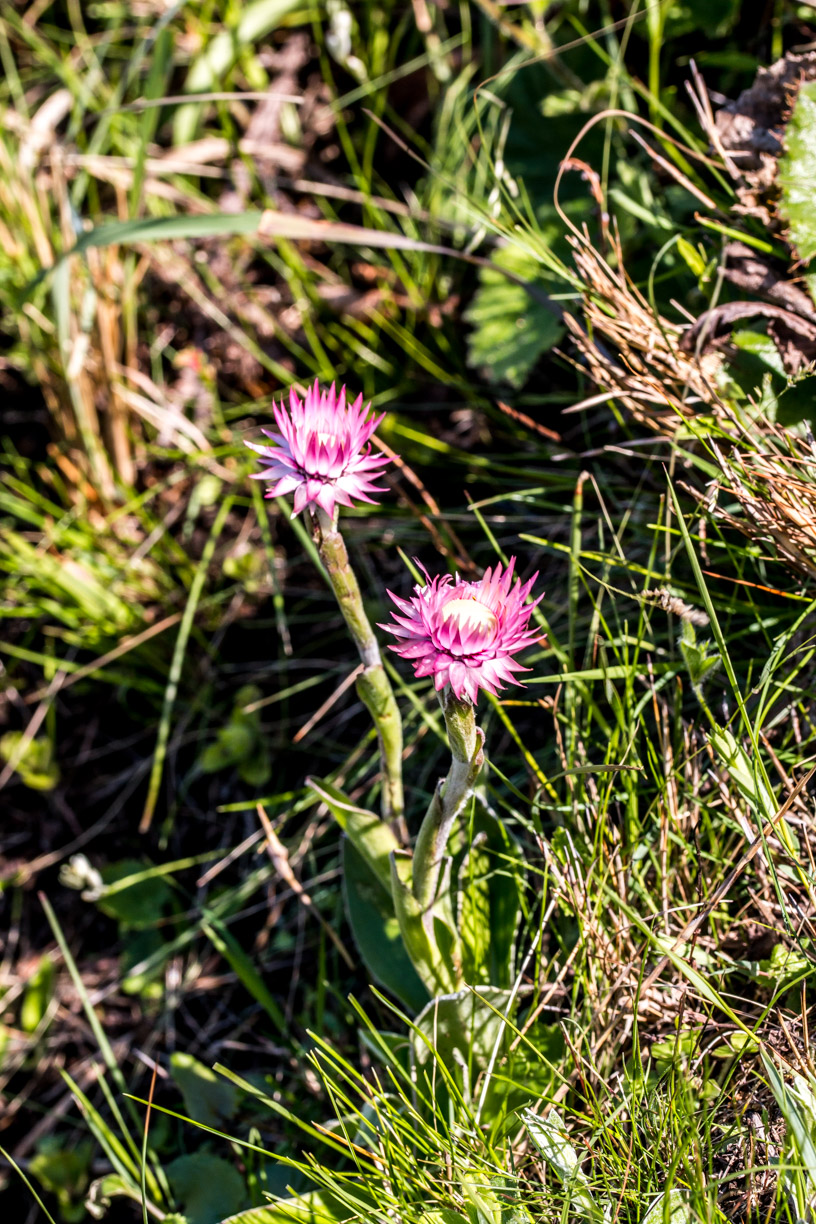
Helichrysum spiralepis

Leobordea pulchra
While we were glad to get out of the wind, we were privileged to have been treated to a rare floral spectacle.

Participants: Anne S, Gail B-W, Graham G, Jean P, Kate G, Maggie A.

Saturday, 14 October 2017

Visits to three grasslands at Ngele (Thursday 12 October, 2017)

Our first objective with this visit was to assist with an assessment of the plant biodiversity of a section of grassland just on the KwaZulu-Natal side of the Umtamvuna river on the lower slopes of the Ngele mountain range. There had not been much rain prior to our visit and accordingly there was not much flowering. The grassland is also used for grazing the sheep from the local community, so the ground cover was very short. The assessment was needed as there is consideration of an application to plant Eucalyptus in the area.

We recorded as many species as we could identify - some in a non-flowering state. A few of these are shown below. We also got good views of the confluence of the Umtamvuna River with the Mafadobo River from this site.

Leobordea pulchra

Striga bilabiata

Basananthe sandersonii

Asclepias cuculata

Confluence of the Umtamvuna (right) and Mafadobo Rivers (above left)

Having completed the survey, we decided to head off to an area where we thought we could find Struthiola anomala and Dioscorea brownii as we have no recent specimens of these species. Although the flowers at this next site were far more prolific, our two target species had failed to appear this early in the season. We nevertheless had an enjoyable time scrambling around on a steep, south-facing slope while looking for them.

Instead we found a number of Geum capense and Helichrysum vernum accompanying Kniphofia baurii, Aspidoglossum flava and Diclis reptans. The wind was howling around our ears while exposed on this slope making photography very difficult so we were glad to move on into a less exposed area.

Afroaster perfoliata

Aspidoglossum flava

Geum capense

Diclis reptans

Helichrysum vernum

Around the corner were some Anemone caffra, one or two Heliophila rigidiuscula, and several of the very attractive Tulgaghia leucantha as well as a single Hypoxis parvula var. albiflora.

Heliophila rigidiuscula

Tulbaghia leucantha

Hypoxis parvula var. albiflora

Once we walked over the crest of the hill, we were shielded from the wind and could relax in the sun and have our lunch. Nearby we found Pachycarpus plicatus and a small patch of the rather imposing Berkheya macrocephala. Dotted around were several eye-catching Raphionacme hirsuta and there were imposing patches of Rhodohypoxis baurii in exposed rock sheets along with a colony of Euphorbia flanaganii.

Pachycarpus plicatus

Polygala amatymbica

Berkheya macrocephala

Raphionacme hirsuta

Rhodohypoxis baurii


Walking back to the vehicles we came across Rhynchosia villosa in flower and a single Ipomoea simplex.


Rhynchosia villosa

Ipomoea simplex

The team for the day with the Ngele range in the background

Our final stop for the day was at a small grassland near the Weza sawmill. This patch was blooming well with a swathe of Kniphofia baurii and we were also lucky to find a few of the leafless but imposing Cyrtanthus contractus.


Ajuga ophridis

Argyrolobium amplexicaule

Cyrtanthus contractus

Kniphofia baurii

Lithospermum papillosum

Kniphofia laxiflora

Eriosema distinctum

By this stage the clouds that had started building up earlier had become threatening and the wind had turned cold, so we were glad to get back to the shelter of the vehicles and head back homewards, satisfied with all we had seen.

Participants: Anne S, Graham G, Jean P, Kate G, Isabel J, Phakamani M.

Sunday, 8 October 2017

A wet day: herbarium work and a short walk (Thursday 5 October 2017)

Plans to walk in the Red Desert Nature Reserve had to be shelved when the predicted rain materialised and so it was only a small group that went to the Umtamvuna reserve to continue re-arranging the voucher collection in the HNTA herbarium at Beacon Hill.

We made good progress with re-naming and moving vouchers around into new families and by lunch time we had reached the last cabinet where we called it a day. By that stage the weather had cleared a little although it was still heavily overcast.

Suitably equipped, we walked in a south-easterly direction. It was not long before we came across a good display of Disa stachyoides poking out above the grass, accompanied by the occasional Disa versicolor. On the rocks we saw the first Cyrtorchis arcuata in bloom.


Disa stachyoides

Disa versicolor

Cyrtorchis arcuata
We walked on past a patch of Satyrium longicauda and reached the wetland just before the stream. By this stage most of the Merwilla plumbea flowers were over but there were still a few Disa similis and more Satyrium longicauda amongst a host of bright yellow Senecio brevidentatus.

Starting up the next slope we soon came across a Boophone disticia coming into flower and standing out against the green grass.
Boophone disticia


Senecio brevidentatus
 About halfway up the hill we saw the first Silene burchellii, these flowers being fully open and enjoying the overcast, damp conditions.


Silene burchellii

Down into the next wetland there was a good showing of the Vulnerable, narrow-endemic Watsonia bachmannii, as well as two Cyperaceae species that require some work to get identified to species level.

Watsonia bachmannii

By then the weather was starting to close in again so we turned back and headed to the office via Ingrid's Falls - not at its best as the stream was flowing with rather muddy water, thanks to some clearing work being done upstream outside the reserve.


Like phantoms in the mist - near Ingrid's Falls
Patrticipants: Anne S, Graham G, Kate G.