Monday, 2 October 2017

Flowering now (October 2017)

It should be noted that these "Flowering now" posts are dealt with incrementally, i.e. new species are added as they are seen each month so readers will not necessarily see all species for the month with a single visit to that post. Also note that we try to avoid including species seen in the previous month, unless the species is particularly notable.

Acalapha peduncularis

Acalapha vilicaulis

Acalypha wilmsii

Afroaster perfoliatus

Ajuga ophridis 

Aneilema aequinoctiale
 
Anemone brevistylis
   
Apodytes abbottii

Argyrolobium amplexicaule
 
Argyrolobium rotundifolium


Asclepias cuculata

Aspidoglossum gracilis

Aspidonepsis flava

Basananthe sandersonii

Berkheya macrocephala

Bersama swinnyi

Caesia contorta

Calodendrum capense

Canthium ciliatum

Canthium inerme

Ceropegia linearis

Cnestis polyphylla

Combretum bracteosum

Combretum kraussii

Crassula virgata

Cryptocarya latifolia

Cyanotis speciosa

Cyrtanthus contractus

Delosperma subpetiolatum

Diclis reptans

Dierama reynoldsii

Dioscorea cotinifolia

Diospyros lycioides

Disa brevicornis

Disa saggitalis

Dodonea viscosa

Dovyalis caffra

Ekebergia capensis

Eriocaulon dregei

Eriosema distinctum

Eriosema populifolium

Eucomis autumnalis

Excoecaria simii

Gerbera ambigua (yellow form)

Gerbera piloselloides (two colour forma)

Geum capensis

Gnidia baurii

Gomphocarpus physocarpus 

Grewia occidentalis

Gymnosporia vanwykii

Harveya pauciflora

Helichrysum spiralepis

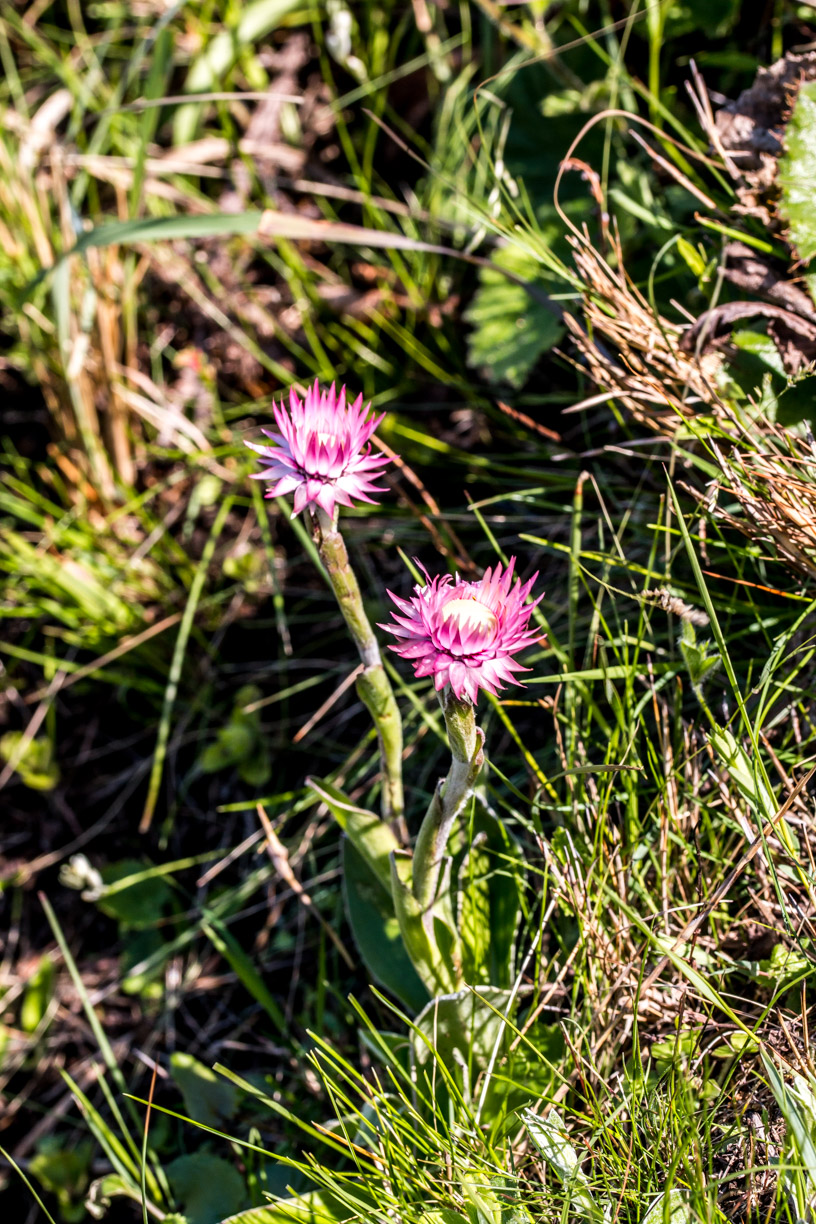
Helichrysum vernum

Heliophila rigidiuscula

Hibiscus aethiopicus

Hybanthis enneaspermis

Hypericum aethiopicum

Hypoxis colchicifolia

Hypoxis flanaganii

Hypoxis membranaceus

Hypoxis parvula var. albiflora

Ipomoea simplex

Kiggelaria africana

Kniphofia baurii

Kniphofia laxiflora

Lasiosiphon triplinervis

Leobordea corymbosa

Leonotis leonurus

Linum thunbergii

Leucadendron spissifolium subsp. oribinum (m)

Leucadendron spissifolium subsp. oribinum (f)

Lithospermum papillosum

Lotus discolor

Monopsis descipiens

Moraea brevistyla

Nemesia caerulea

Nymphoides thunbergiana

Ophrestia oblongifolia

Pachycarpus plicatus

Peddiea africana fruits

Pelargonium schlechteri

Pittosporum viridiflorum

Plectranthus oertendahlii

Plectranthus zuluensis

Polygala refracta

Raphionacme hirsuta

Rhodohypoxis baurii

Rhoicissus tomentosa

Rhynchosia cooperi

Rhynchosia villosa

Rinorea domatiosa

Satyrium rhodanthum

Schizoglossum cordifolium

Searsia rudatisii

Senecio brevidentatus

Silene burchellii

Sisyranthus imberbis

Sisyranthus virgatus

Stachys nigricans

Strelitzia nicolai

Streptocarpus haygarthii

Striga bilabiata

Strophanthus speciosus

Tabernaemontana ventricosa

Trimeria grandiflora

Tritonia disticia

Tulbaghia leucantha

Turraea floribunda

Utricularia livida

Watsonia bachmannii

Watsonia densiflora

Watsonia inclinata

Xysmalobium gerrardii

Zantedescia aethiopica

Friday, 29 September 2017

Another good spring display at the Western heights (Thursday 28 September 2017)

It was overcast and cold when we gathered at Beacon Hill but we decided to take the chance that the rain would hold off during our walk and set off to the Western Heights. We were joined on this occasion by Moraea Phillips who had learned about our walks from this blog, as well as two research students from UKZN, Miguel Castañeda-Zárate and Carolina Diller who are looking at sorting out the Satyrium longicauda species complex.

We parked near the gate and immediately noticed several large patches of yellow flowers in the distance and decided to head in that direction. These turned out to be Senscio heliopsis and were growing in a wetland. Walking through the wetland proved to be challenging as it was necessary to step from tussock to tussock to avoid getting bogged down.


Wetland patch of Senecio heliopsis

Senecio heliopsis


While there were Satyrium longicauda buds scattered around the proximity of the wetland,  these were not open. There were also many Ledebouria cooperi hiding amongst other herbs and a myriad of Eriospermum cooperi showing their white inflorescences about half a meter tall. In the wetland the fruits of Cyrtanthus breviflorus could be seen everywhere, the remnants of the flowering show covered in an earlier blog post.

Once across the wetland we were on more even ground and progress was easier. We soon came across the first of the Merwilla plumbea patches - and we were to see many on this walk, as they cast a blue haze over the grasslands.

Merwilla plumbea
 
Merwilla plumbea buds

The blue haze of hundreds of Merwilla plumbea
We walked on, passing several more of these Senecio and Merwilla patches. It was evident that for this area, we were about a week or so too early to get the full impact of the flowers as many of the species were in bud - a follow-up visit is certainly warranted.

We walked along the cliffs until we found a spot where we could see the view down into the Umtamvuna gorge but were sheltered from the cold wind while we had lunch. On the way back we first headed up a small hill to see if we could find any Euphorbia bupleurifolia plants, as we know that they occur in this area. After a lot of searching we found one, and then nearby, another with fruits.

Euphorbia bupleurifolia
Having confirmed that these plants were still present we walked back down to the stream where we could see Genlisea hispidula and Disa tripetaloides.  In a firebreak area which had been burned about four weeks earlier than the block burn we had walked on for most of the day, we saw most of the same species but with the flowering more advanced. We were even lucky enough to find a Brachystelma australe flowering on a rock plate.


Brachystelma australe

Here the Satyrium longicauda, Sopubia simplex, Eriosema umtamvunense and Kniphofia pauciflora were all flowering well. We even saw remnant flowers on a few Disa similis and the first of the Disa versicolor were starting to show themselves. We strolled along, enjoying this show until we came to a special find, Watsonia pondoensis, probably flowering better than we have seen them before. This narrow-endemic, Endangered species is not often found and we only know it form a few locations on the Western Heights.

Watsonia pondoensis

Watsonia pondoensis
Our luck stayed with us - although both a phone and a camera were lost during the walk, both were rather miraculously recovered.

Participants: Anne S, Carolina D, Gail B-W, Graham G, Kate G, Maggie A, Moraea P, Miguel C-Z, Sarah B-W, Uschi T.


Saturday, 23 September 2017

Vernon Crookes NR with UKZN students

We arranged to meet Prof. Benny Bytebier and four of his students to accompany them on a walk through the grasslands and forest margins of this reserve. We met along the road towards the reception offices where we were looking at a small population of Haemanthus deformis in the shade of a small bush clump. Nearby we found Jasminum multipartitum with its star-like white flowers, Thunbergia natalensis, Ipomoea plebeia and some robust-looking Gerbera ambigua.


Haemanthus deformis in fruit

Thunbergia natalensis

Jasminum multipartitum


With one of the students, Tanya, focussing her Masters research on Euphorbiaceae we made a point of looking for plants in that family. These included members of the genera Acalypha, Clutia, Croton and Macaranga. It was interesting to note that while there were many Croton sylvatica, very few had flower buds.

In one area we found several of the Endangered, narrow-endemic Searsia rudatisii, some in flower. In the same grassland area we found a few Triglochin milnei in flower.


Searsia rudatisii

Triglochin milnei

Growing in cracks in some of the granite boulders, we found Ochna arborea putting on a show with its bright gold flowers.


Ochna arborea


Another species we encountered that enjoys the proximity of such rock outcrops was one to warn the students about -- Obetia tenax, the tree nettle, has a fierce sting to plague the unwary. Otherwise, this is an attractive small tree.


Obetia tenax

Ledebouria revoluta flowers were very much in evidence in the grasslands, some having multiple inflorescenses.


Ledebouria revoluta

Other plants we saw included Monopsis decipiens, Drimia elata and Canthium suberosum.


Canthium suberosum in fruit

Posed in front of a large granite boulder

Participants: Amy S, Benny B, Gail B-W, Graham G, Kate G, Phakamani M, Sthembile N, Tanya M, Uschi T, Zodwa M.