We were lucky to get accommodation at Gwe Gwe camp in Mkhambathi Nature Reserve, but for various reasons, members of our CREW group were unable to join us. We were however, able to entice Rudi and Lize van Staden away from Pretoria to make their first proper visit to this wonderful reserve. We reached the reserve gates around midday and having made arrangements at reception for the next day, unpacked and had lunch at Gwe Gwe cottages.
That afternoon we set off across the beach and into the grassland beyond. It was not long before we tracked down a small colony of Holothrix burchellii that we had seen in fruit on a previous visit. On this occasion there were several in flower. This represents a range extension for this species, with the previously known northernmost population over 100 km to the south west.
 |
| Holothrix burchellii |
The grasslands in this part of the reserve had not been burned this year and we struggled through long grass and Smilax anceps as we headed up the coast. We found Eriosema dregei and Burchellia bubalina in flower and plenty of Diospyros scabrida both in flower and in fruit, the latter looking splendid in the late afternoon sun.
 |
| Diospyros scabrida |
Nestled between some rocks almost in the splash zone were some tall Albuca virens most with dried seed heads and some hardy Hypoxis villosus. We also came across several Kniphofia littoralis flowering in the tall grass as well as some clusters of Geranium flanaganii.
 |
| Albuca virens |
 |
| Hypoxis villosus |
 |
| Geranium flanaganii |
At the beacon marking the limit of the area where shore fishing is permitted, we turned inland to see if we could find some burned grassland to make walking easier. This gave us an opportunity to look back at Gwe Gwe in the distance. We were thrilled to see an Osprey fly past over the sea.
While we did not find any newly burned areas, we did come across more flowering plants. On the slopes leading to the Gwe Gwe river we found Merwilla plumbea, while in the still water in a pond were two water plants, Nymphaea nouchali and Potamogeton nodosus. On the banks of the stream were several Leucadendron pondoense and Eriocaulon dregei with Disa tripetaloides in flower.
 |
| Gwe Gwe bay |
 |
| A still pond on the Gwe Gwe river |
 |
| Leucadendron pondoense |
 |
| Eriocaulon dregei |
 |
| Gwe Gwe River and lagoon |
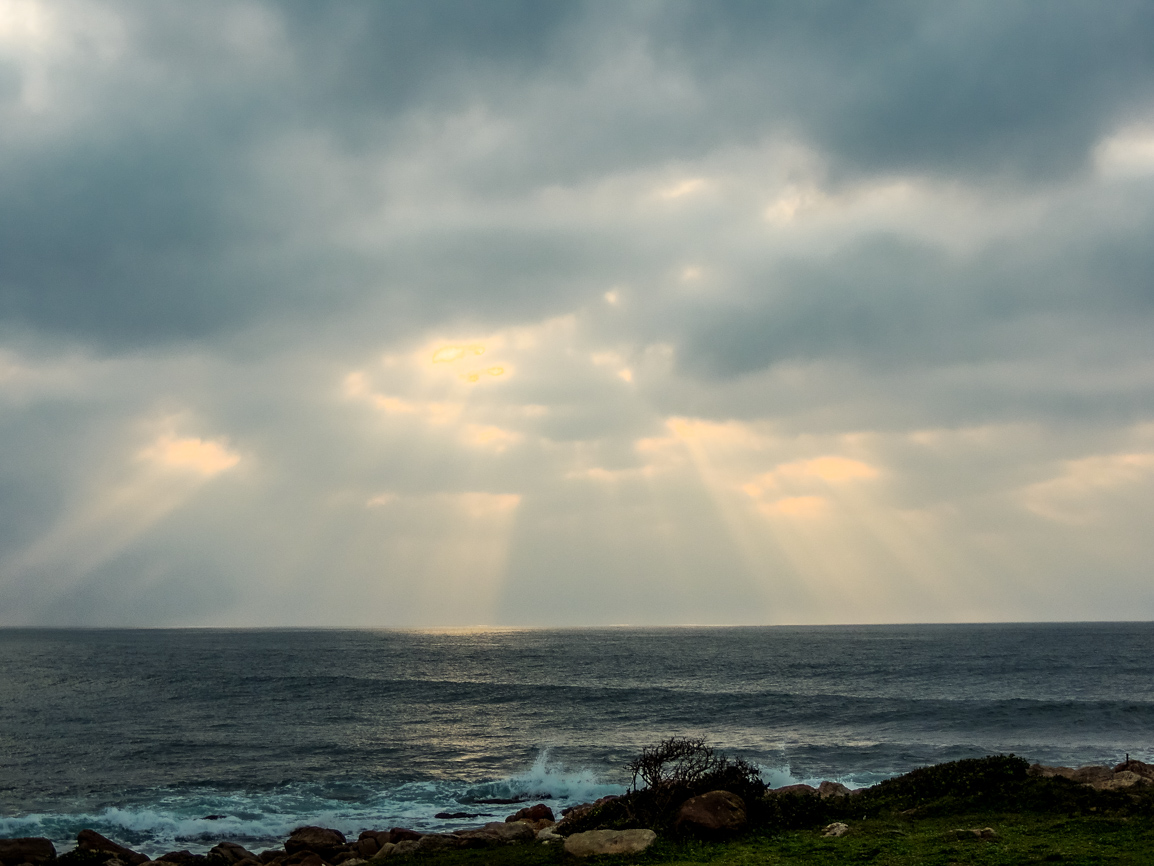
We enjoyed a late afternoon swim at the beach at Gwe Gwe. Next morning we were greeted by a rather cloudy sky which produced a dramatic sunrise to start the day's activities. We were also enthralled by the sight of many dolphins lazily moving through the gentle waves in the bay just in front of our cottages. In the distance we could also see whales splashing and blowing.
We set off to collect our guide for the day, Mr Sonwabile Jack, and headed to the Reserve's wilderness area where we were to explore some burned grasslands.
 |
| Sunrise at Gwe Gwe |
At the first stream crossing we found Denekia capensis, and a short distance downstream were several Struthiola pondoensis flowering in great abundance, with Cliffortia odorata growing nearby.
 |
| Denekia capensis |
 |
| Struthiola pondoensis |
At the second river crossing we stopped to look at Erica cubica before bumping across the river and heading on.
 |
| Erica cubica |
We soon arrived at the first of the burns and stopped to look around. Here we found Dierama tysonii, Lotononis bachmanniana, Senecio speciosa and Disa brevicornis. We were also lucky to find Eriosema latifolium in flower. There was quite a size-able population of this Vulnerable narrow-endemic species in this area.
 |
| Dierama tysonii |
 |
| Disa brevicornis |
 |
| Eriosema latifolium |
We then drove to the edge of the Mtentu River gorge where we found Adenocline pauciflora.
 |
| Looking upstream at the Mtentu River gorge |
 |
| Adenocline pauciflora |
We then drove towards the sea but stopped to have lunch under a Syzygium tree next to a small group of Helichrysum diffusum. An after-lunch stroll revealed Disa similis, Ornithogalum paludosum, Utricularia prehensilis, Aristea gerrardii, Eriospermum cooperi and Leucadendron spissifolium subsp. natalense in a wetland.
 |
| Helichrysum diffusum |
 |
| Leucadendron spissifolium subsp. natalense |
We reached an area with more floral abundance near the sea and were soon blown away by the sight of hundreds of the Vulnerable narrow-endemic species Kniphofia drepanophylla growing in a wetland. These were accompanied by Disa similis, Satyrium longicauda, Eriospermum cooperi and old flower stalks of Merwilla plumbea. It was clear that this area required more time to explore thoroughly and we decided to return the next morning.
 |
| Kniphofia drepanophylla |
We stopped off at Mkhambathi Falls and walked upstream to look at the Strandlooper Falls.
 |
| On a bank of the Mkhambathi River just below Strandlooper Falls |
The next morning we were again treated to the spectacle of dolphins playing in the waves just outside our cottages.
 |
| Sunrise at Gwe Gwe - just after the dolphins left |
We stopped to investigate a small forest patch on our way back towards Mosquito Beach and here we saw many Mitriostigma axillare flowering in the undergrowth. Accompanying them were Hyperacanthus amoenus and Appodytes dimidiata.
 |
| Mitriostigma axillare |
After leaving the forest patch we stopped just above Mosquito Beach and walked around the grassland well covered in flowers. Amongst them were Oxygonum dregei, Convolvulus natalensis and Cucumis zeyheri as well as Delosperma subpetiolatum and Lampranthus fugitans on the rock plates. The whole area was covered in Triglochin milnei, many of which were already producing fruit.
 |
| Convolvulus natalensis |
 |
| Cucumis zeyheri |
 |
| Delosperma subpetiolatum |
 |
| Triglochin milnei |
We walked over the narrowest part of the estuary and made our way up the slope on the east bank. We were immediately amongst Hesperantha baurii and as we worked our way up the slope, we started seeing lots of Satyrium longicauda and patches of Polygala fruticosa.
 |
| Polygala fruticosa |
Over the top of this slope we came to another wet depression with an expanse of Kniphofia drepanophylla. Here we found a white Hesperantha which, after studying reference books appears to be Hesperantha hygrophila.
 |
| Hesperantha hygrophila |
 |
| Walking through the flowers near Mosquito Beach |
We then walked around some forested coastal dunes encountering more Kniphofia drepanophylla in the wet areas while there were Kniphofia littoralis in the adjacent grasslands and Kniphofia coddiana amongst the rocks. Just before we reached the beach we found a few Kniphofia rooperi in a boggy area. We walked back to Mosquito Beach along the beach and after a quick swim, had lunch in the shade of some Mimusops caffra trees.
With the weather threatening, an abrupt change after swimming in bright sunshine, we headed inland again, but slightly south of our previous route, and soon came across the first specimens of Kniphofia pauciflora. Nearby at the edge of the stream we found Argyrolobium baptisioides. Feeling the first drops of rain, we hurried on noting the first of the Moraea elliottii opening despite the gloomy conditions. Although it was an early end to the day's exploration, we had had a good day.
 |
| Kniphofia pauciflora |
 |
| Argyrolobium baptisioides |
Unfortunately the next morning's planned trip to the Superbowl had to be cancelled because of limited time and adverse weather, so we bid the staff at Mkhambathi goodbye and set off homewards.
Participants: Graham G, Kate G, Lize v S, Rudi v S, Sonwabile J.