As Scilla kraussii was expected to be in flower we decided to walk up to the beacon at Beacon Hill to see how they were doing. On the way there Anne took off to chase some stray cattle out of the gate before they could enjoy too many of the new plants sprouting in the fire break along the fence line.
 |
| Anne chasing cows |
In close proximity there were a few scattered Watsonia mtamvunae.
 |
| Watsonia mtamvunae |
Further along there was a colony of what we believe to be Gladiolus inandensis - still to be confirmed.
 |
| Gladiolus cf inandensis |
In the unburned grassland adjacent to the fire break we found the first of the short-spurred form of Eulophia parviflora. This has a much more compact inflorescence than the more common form and has upward turned flowers.
 |
| Eulophia parviflora (short spurred form) |
There were several species of Hypoxis flowering. Hypoxis costata shown below had probably the biggest flowers. There were also many Ledebouria revoluta just starting to flower.
 |
| Hypoxis costata |
 |
| Ledebouria revoluta |
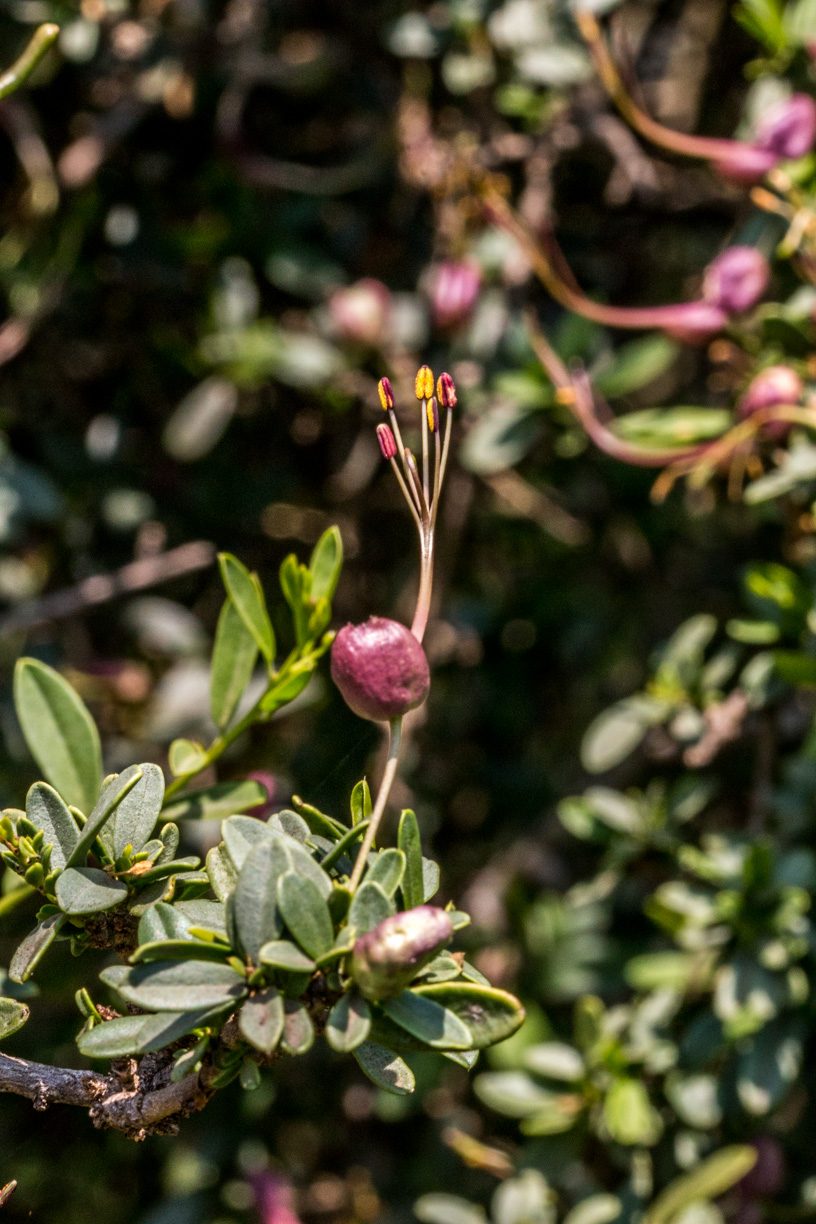
At the first rock outcrop we found the first flowers on a Canthium vanwykii as well as Eriosema salignum in flower.
 |
| Canthium vanwykii |
 |
| Eriosema salignum |
When we reached the rock outcrop on which the commemorative plaque is mounted, we were rewarded by the sight of many Merwilla kraussii in flower. While this species has been sunk into Merwilla plumbea, it is not something we are comfortable with, given its very different growth and habitat. This species grows in clusters in little, if any, soil on bare rock and the bulbs remain small. The inflorescence is also much smaller than Merwilla plumbea.
 |
| Merwilla kraussii |
 |
| Typical cluster of Merwilla kraussii |
 |
| Merwilla kraussii growing in a rock depression together with Polystachya pubescens |
We stopped for lunch here and afterwards headed down to the little dam in the gully we call Mr Nic II - the second stream inland from the offices at Beacon Hill.
 |
| Our lunch stop |
 |
| Battling down the steep slope |
After crossing at the dam we worked our way down the fringe of forest along the stream and then found a crossing place richly endowed with Clivia robusta.
 |
| The stream in Mr Nic II |
Heading back to the office through rather long grass we came across a mixed colony of the two subspecies (oribinum and natalense) of Leucadendron spissifolium.
 |
| Leucadendron spissifolium subsp. natalense |
Participants: Anne S, Dorothy M, Graham G, Kate G, Maggie A, Mervyn T, and Uschi T.