One of our CREW target species is the Critically Rare succulent Caputia oribiensis which was described from collections made near the Oribi Gorge Hotel. We looked for this cremnophylous species along a different section of these cliffs last year but we failed to find it, probably because we visited well after the reported flowering period. This year we decided to try much earlier, and on last Thursday, started looking along the cliff edges near the hotel.
The closely related cremnophyte, Caputia medley-woodii was common and obvious on the cliff edges with its bright yellow flowers. The important characters that distinguish this species from C. oribiensis are the teeth on the upper portion of the leaves, the felted upper and lower surfaces of the leaves, and the flower buds which are held upright.
 |
| Caputia medley-woodii |
While we saw several other interesting plants along these edges there was no sign of Caputia oribiensis. There was a Gymnosporia nemorosa covered in flowers, and clambering through a nearby shrub, Sarcostemma viminale, also in flower. Not far away we found a plant which looks very similar to Sarcostemma viminale when not in flower, Cynanchum gerrardii.
 |
| Gymnosporia nemorosa |
 |
| Sarcostemma viminale |
 |
| Cynanchum gerrardii |
The views down into the Umzimkulwana gorge from here are certainly spectacular, and further on there is an overhanging rock.
 |
| A horseshoe bend in the Umzimkulwana river |
 |
| The overhanging rock with the "Mind the Edge" sign |
We did not manage to find anything resembling Caputia oribiensis along this section of the cliffs and, as the vegetation behind the cliffs is badly degraded by alien invasive species it is a bit depressing, so we decided to try another section of the cliffs. Here we immediately found a Gymnosporia glaucophylla covered in white flowers.
 |
| Gymnosporia glaucophylla |
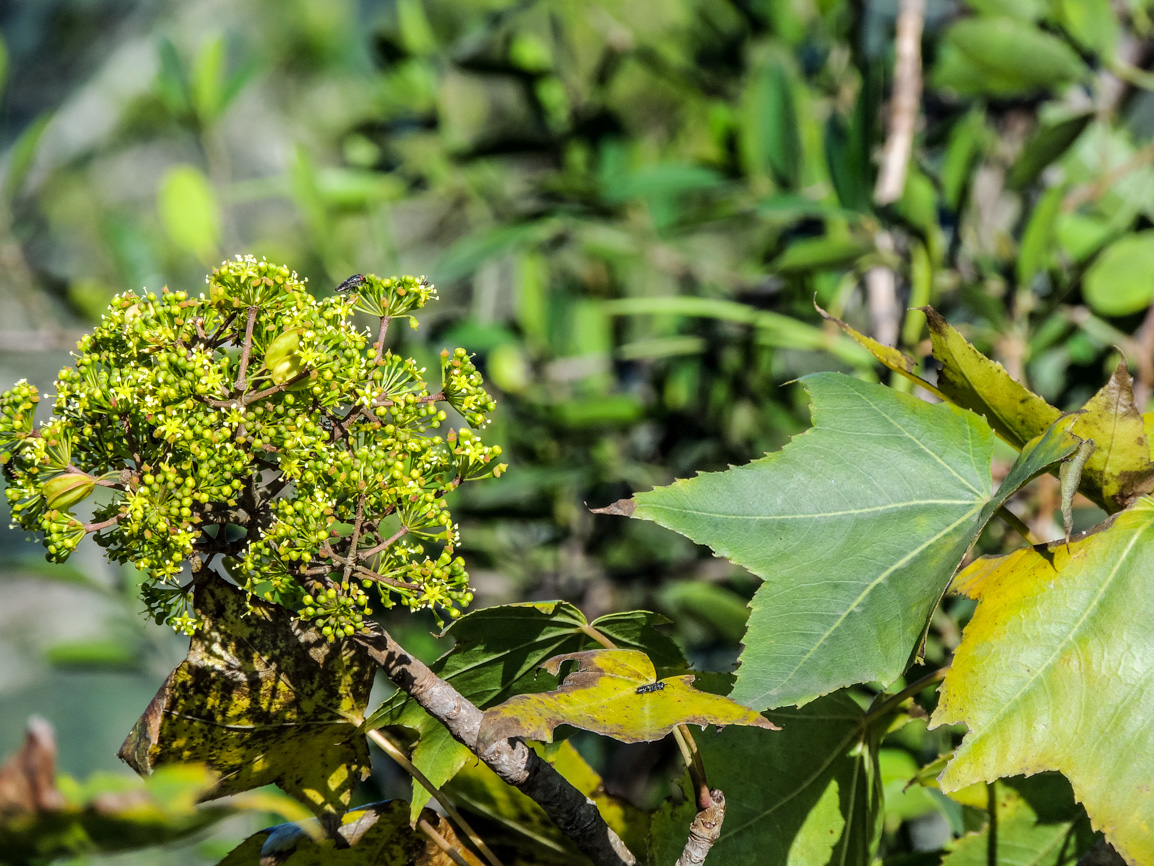
A little further growing just below the cliff edges we found the Near Threatened endemic Rhynchocalyx lawsonioides in fruit and the fairly unusual Seemannaralia gerrardii with clusters of yellow-green flowers.
 |
| Rhynchocalyx lawsonioides |
 |
| Seemannaralia gerrardii |
There were many succulents on and under the rocks along the cliffs. Crassulaceae were well represented, amonst others Crassula obovata, Crassula orbiculata, Crassula perforata var brachypetala, and Crassula perforata var perforata, Cotyledon orbiculata and Cotyledon velutina and Kalanchoe rotundifolia.
 |
| Cotyledon velutina |
 |
| Crassula orbicularis |
We finally came across a plant which might be Caputia oribiensis but this awaits specialist confirmation. Apart from this find, the walk concluded on a high note and the last section of cliffs visited are in a much better condition with few if any alien invasives.
Update: 5 May 2016
The plant suspected to be our target species, Caputia oribiensis, unfortunately turned out to be an atypical Kleinia fulgens - so the search goes on!
Participants: Anne S, Dorothy M, Graham G, Kate G, Uschi T.