Monday, 16 January 2017

More plant rescue surveys: Msikaba North (Thursday 12 January 2017)

Fortunately we were able to drive to the point where we stopped the survey previously, so we could get going quickly. On this occasion we were also accompanied by the site staff of Simply Eviro JV. It took some time to work our way through a small forest patch as there was no cleared survey line but only an overgrown cattle trail. In the forest there were also more species to look at so this first section took some time.

In this forest patch there is a big stand of invasive Solanum chrysostrichum. It is unclear what allowed this species to penetrate the forest, but mans' presence is strongly evident in the forest. Here we saw  Stephania abyssinica in fruit and a large Agelanthus krassianus in a tree. There were several Cussonia sphaerocephala in this forest, the one depicted below being particularly obvious. 


Getting started with the survey
Agelanthus kraussianus
Cussonia sphaerocephala
Stephania abyssinica
Once back in the grassland the progress was quicker as these well-grazed grasslands have poor species diversity. As we crossed a small hill we came across a large stand of the invasive (and probably planted) Plectranthus barbatus, in this case sheltering a patch of Transkei Gold. There were a few Syncolostemon densiflorus on this hillside.


Syncolostemon densiflorus
Down this hill and across a small wetland and we were on the last flat section leading to the bridge site. Along this section we saw Leucas lavandulifolia, and apart from a few Pachycarpus species with fruits, there was little else to see other than an Ipomoea simplex  before we reached the edge of the gorge.


Leucas lavandulifolia
Ipomoea simplex
The bridge site from the south bank of the Msikaba river
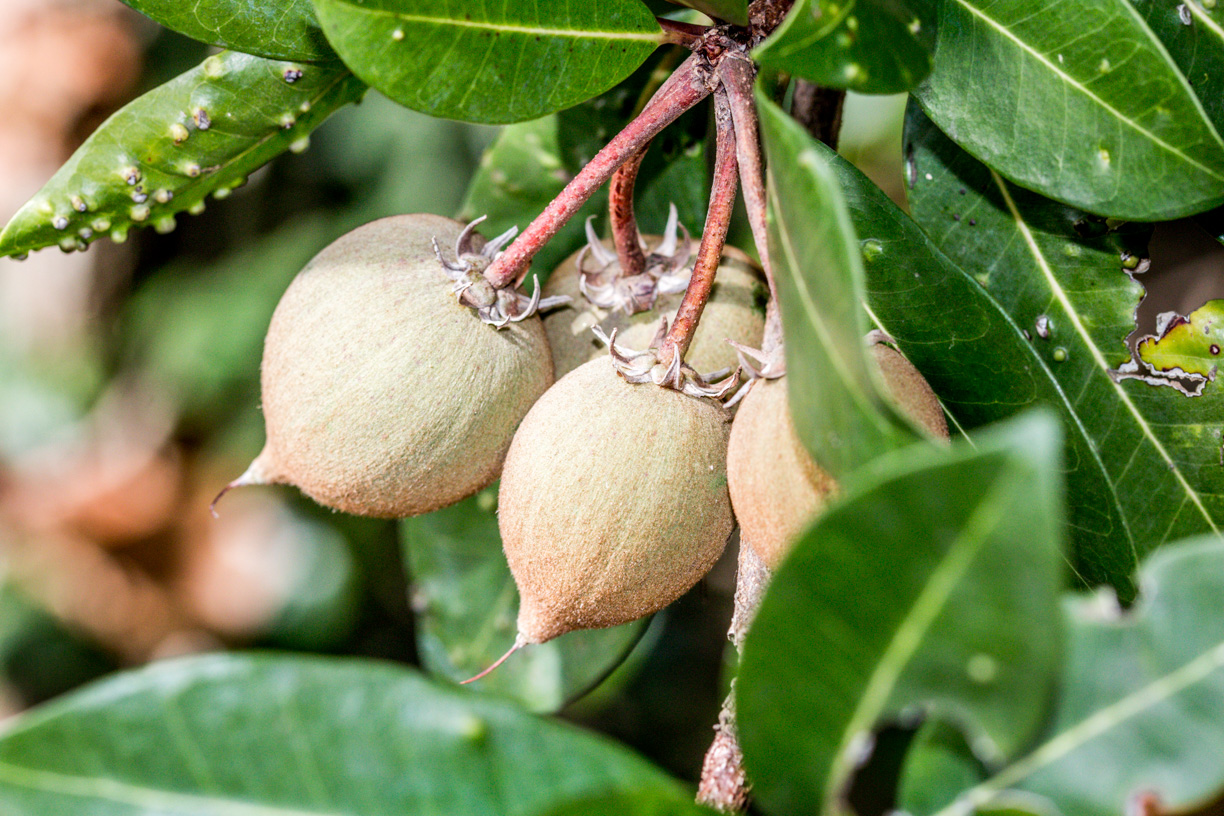
There were some interesting plants along the edge of the gorge, including some Pondoland endemic species such as Manilkara nicholsonii and Cryptocarya wyliei and Searsia acocksii.

Walking back after completing this part of the survey
On the way back, Dorothy and Anne and Gail came across two orchid species in flower in a small watercourse, Disa polygonoides and Satyrium trinerve. We saw several other dead stalks of unidentifiable orchid species: some seemed to be Eulophia.


Disa polygonoides
Satyrium trinerve

Participants: Anne S, Bjorn W(SE JV), Dorothy M, Gail B-W(SE JV), Graham G, Kate G, Kothiya N(SE JV), Xolani X(SE JV), Zameka T(SE JV).

Wednesday, 11 January 2017

A day trip to Ntsikeni Nature Reserve

January is usually a premier flowering period at Ntsikeni nature reserve. As we expected there to be no accommodation available and as we needed to deliver some equipment to Richard Braby at Underberg, we decided to do a day trip into Ntsikeni with Richard and Julie. It turned out that we were the first visitors to the reserve since the end of December so the accommodation had been there for the asking.

We had carefully selected a day with a forecast of overcast but dry conditions, which would allow us to enjoy a full day in the grasslands. On the way from Underberg, we had a couple of stops -- the first was a small wetland on a farm where we found a few Disa scullyi together with one or two Disa rhodantha.


Disa scullyi
Disa rhodantha
We continued towards the turnoff at Franklin, keeping an eye out for Nerine appendiculata at the roadside but saw no sign of these at any of the locations where we have previously seen them. Not far after Franklin, driving along a newly tarred road, Julie saw more orchids at the roadside so we made another stop to have a closer look. In this wetland, despite exposure to a large herd of cattle, we found more Disa scullyi and a fairly large population of Satyrium hallackii, ranging in colour from a pale to fairly intense pink . There were also a few Corycium - these will have to be checked to confirm the identity of the species.
Satyrium hallackii
After one or two additional stops along the Ntsikeni access road to check out small forest patches, finding a number of flowering Gloriosa modesta in one patch, we finally arrived at the reserve gate and in misty and low cloud conditions headed for the first wetland. Here we found many more Disa scullyi (amongst them an unusual white form), a number of Gladiolus papilio, some very robust Satyrium longicauda and a few very tall Disa chrysostachya. Several Melasma scabrum showed their yellow flowers in this grassy marsh.
 
Disa scullyi

Gloriosa modesta
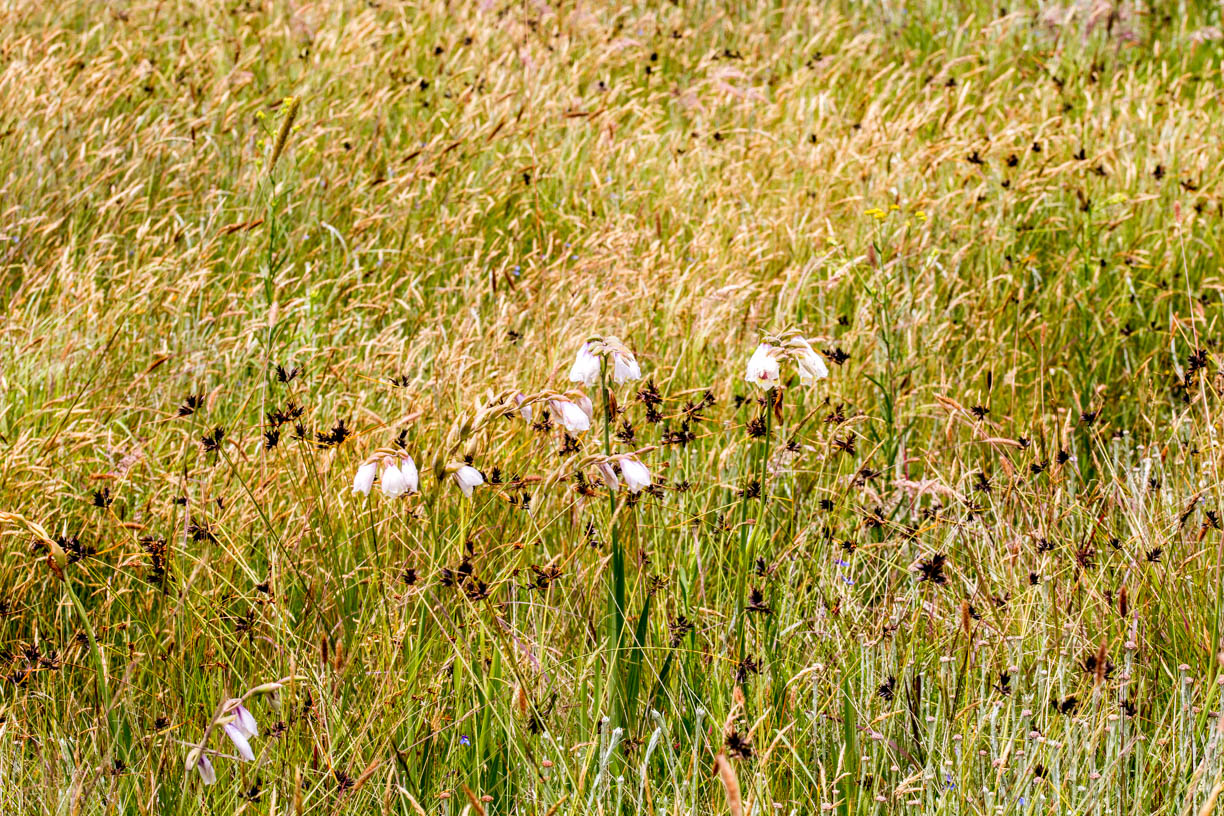
Gladiolus papilio
Disa chrysostachya
Melasma scabrum
There were also some Habenaria schimperiana buds in this wetland but no open flowers. Several Watsonia lepida flowers on the nearby hillsides caught our eyes but we could find none of the mimic species, Disa pulchra, amongst them.


Watsonia lepida
We drove onwards to a dolerite ridge, known to be home to a wide diversity of species. Here it was not long before we found several clumps of Eulophia zeyheriana accompanied by scattered Kniphofia laxiflora.
 
Eulophia zeyheriana

Kniphofia laxiflora
There was also a patch of the dwarf suffrutex Pygmaeothamnus chamaedendrum with shiny green fruits.
Pygmaeothamnus chamaedendrum
A little further Julie found the only flowering specimen of the very attractive but yet-to-be-described Xysmalobium sp. Soon after this we found ourselves amongst scattered Disa cornuta.


Xysmalobium sp.
Disa cornuta
We walked on, starting a stampede of a herd of Black Wildebeest and found a small population of Satyrium hallackii in a wetland. Small flowers of Aponogeton junceus presented their heads above the water here.


Wildebeest on the run
Aponogeton junceus
Further back towards the vehicle we found a beautiful group of Kniphofia laxiflora. We drove further, unsuccessfully checking other areas for Habenaria schimperiana and then stopping for lunch in the shade of a large tree. After lunch we visited the lodge and greeted the caretaker, Dalu Ngobo, from whom we learned of the availability of accommodation. We then searched the wetlands in front of the lodge where we found only one Disa cooperii. We also saw Epilobium salignumChironia krebsii, and Wahlenbergia rivularis growing close to the stream.

Epilobium salignum

Chironia krebsii
Wahlenbergia rivularis
We then set off homeward (passing the only Brunsvigia natalensis we saw in the reserve), but outside the reserve I managed to persuade Richard to make a small detour to explore a roadside cliff.  This proved to be a worthwhile detour as there were many Cyrtanthus epiphiticus in flower on the cliffs.

Brunsvigia natalensis
Cyrtanthus epiphyticus
While we had an extremely productive day, it seemed to us that there were far fewer flowers this year than we normally have come to expect at this time of year. It is possible the flowering has been delayed as we would expect the Habenaria schimperiana to be flowering well by now. Perhaps a return visit might be warranted.


Participants: Graham G, Julie B, Kate G, Richard B.

Saturday, 7 January 2017

Flowering now (January 2017)


Abrus laevigatus
Acalypha glabrata
Alectra sessiliflora
Aloe linearifolia
Antherotoma debilis
Aponogeton junceus
Asclepias cultriformis
Aspalathus dahlgrenii (ined.)
Begonia sutherlandii

 Berkheya bipinnatifida
Berkheya erysithales
Bowiea volubilis
Brachycorythis tenuior


Brachystelma australe
Brownleea coerulea
Brunsvigia natalensis
Bulbine abyssinica
Caesia contorta
Calodendrum capensis
Capparis brassii 
Ceropegia carnosa
Chaenostoma floribundum
Chaetacme aristata
Chamaechrista mimusoides
Chionanthus foveolatus subsp. tomentellus
Chironia albanensis
Chironia krebsii
Chironia palustris

Cineraria albicans
Cleome monophylla
Combretum kraussii
Convolvulus saggitatus
Crabbea hirsuta
Crassula ericoides
Crassula pellucida subsp. brachypetala
Crassula vaginata
Cyphia elata
Cyphostemma rubroglandulosa
Cyrtanthus epiphyticus
Cyrtanthus sanguineus
Cysticapnos pruinosa
Delosperma lineare
Dierama argyreum

Diospyros scabrida
Disa chrysostachya
Disa cornuta
Disa cooperii
Disa rhodantha
Disa scullyi
Epilobium salignum
Eriosema parviflorum
Eucomis comosa var. comosa
Eulophia horsfallii
Eulophia tenella
Eulophia zeyheriana
Faurea macnaughtonii
Gasteria croucheri
Gerbera sylvicola
Gladiolus papilio
Gloriosa modesta
Gloriosa superba
Gomphocarpus rivularis
Harpephyllum caffrum
Helichrysum cymosum
Helichrysum panduratum
Helixanthera woodii
Heteromorpha arborescens var. abyssinica
Hypoxis nivea (ined.)
Indigofera abbottii
Indigofera hedyantha
Indigofera herrstreyi
Indigofera shilowanensis
Ipomoea plebia
Ipomoea simplex
Kniphofia laxiflora
Leonotis intermedia
Leucas lavandulifolia
Melasma scabrum
Microglossa mespilliformis
Milletia grandis
Miraglossum superbum
Moraea brevistyla
Nymphoides thunbergiana
Oldenlandia herbaceum
Oldenlandia rosulata
Olea sp. nov. 
Pachycarpus grandiflorus
Pavetta bowkeri 
Pavetta gracilifolia
Platycarpha glomerata
Plumbago auriculata
Pollichia campestris
Polystachya modesta
Potamogeton nodosus
Pseudoscolopia polyantha
Psydrax obovata
Pygmaeothamnus chamaedendrum
Rhoicissus tridentata
Ruttya ovata
Scadoxus multiflorus subsp. katharinae

Schrebera alata
Sebaea natalensis
Senecio rhyncholaenus
Shirakiopsis elliptica

Sideroxylon inerme
Smilax anceps
Stenosemis angustifolius
Stephania abyssinica
Struthiola pondoensis
Syncolostemon densiflorus
Syzygium gerrardii
Tephrosia grandiflora
Tephrosia bachmannii 
Tephrosia polystachya
Thunbergia dregeana
Tridactyle bicaudata subsp. rupestris
Trimeria grandiflora fruits
Utricularia sandersonii
Utricularia stellaris
Vitellariopsis marginata fruits
Wahlenbergia rivularis 
Watsonia bachmannii
Watsonia lepida
Xysmalobium sp. nov.
Xysmalobium tysonianum
Zaluzianskya microsiphon
Zantedeschia albomaculata
Zanthoxylum capense fruits
Zornia linearis