Saturday, 7 May 2016

Autumn amble on the Western Heights

As there were several plants we wanted to check up on we decided to return to some locations on the Western Heights. We were pleased to see on our arrival at the reserve gate that a start had been made on the management burns. Not unexpectedly, the fires had stimulated flowering from Cyrtanthus breviflorus and Gerbera natalensis, the latter sporting their woolly winter pajamas.
Cyrtanthus breviflorus
Gerbera natalensis
At this time last year a Scolopia mundii in a forested gully was full of orange fruits but this year there was no sign of fruit. 
 
Scolopia mundii in 2015

Nearby we found Eugenia verdoorniae and Eugenia umtamvunensis, both appearing to have only modest degrees of rust infestation. On an east-facing part of the cliffs we found Mystroxylon aethiopicum with several bright red fruits and close by there was a cluster of Erianthemum dregei flowers.
Mystroxylon aethiopicum
Erianthemum dregei
After a brief look in the gully to see if the Angraecum pusillum were flowering - they were - we headed across the stream and around a buttress and found a rather large cave to check for rock art (which required a bit of a scramble) - again no luck.

Scrambling across to the cave
The group with Anne climbing Tietiesberg in the background
Above these cliffs we found a small patch of very bright crimson Erica cerinthoides - a bit of a contrast to the normal orange colored flowers.


Leaving here we drove across to Iron Crown to see if there were more Erica cerinthoides flowering but unfortunately there were few flowers and these were only found after a rigorous search. On the way back we stopped to look at a small wetland - on the nearby rocks were clusters of Rhipsalis baccifera covered in fruit. The rocks themselves sculpted rugged silhouettes against the sky.
Weathered rocks
Rhipsalis baccifera - our only indigenous cactus
In the open grassland on the way back we found a small cluster of Aspalathus gerrardii, some in flower.
Aspalathus gerrardii
Participants: Anne S, Dorothy M, Graham G, Kate G, Uschi T.

Saturday, 30 April 2016

Caputia conundrums on the Umzimkulwana cliffs

One of our CREW target species is the Critically Rare succulent Caputia oribiensis which was described from collections made near the Oribi Gorge Hotel. We looked for this cremnophylous species along a different section of these cliffs last year but we failed to find it, probably because we visited well after the reported flowering period. This year we decided to try much earlier, and on last Thursday, started looking along the cliff edges near the hotel.

The closely related cremnophyte, Caputia medley-woodii was common and obvious on the cliff edges with its bright yellow flowers. The important characters that distinguish this species from C. oribiensis are the teeth on the upper portion of the leaves, the felted upper and lower surfaces of the leaves, and the flower buds which are held upright.
Caputia medley-woodii

While we saw several other interesting plants along these edges there was no sign of Caputia oribiensis. There was a Gymnosporia nemorosa covered in flowers, and clambering through a nearby shrub, Sarcostemma viminale, also in flower. Not far away we found a plant which looks very similar to Sarcostemma viminale when not in flower, Cynanchum gerrardii.
Gymnosporia nemorosa
Sarcostemma viminale
Cynanchum gerrardii
The views down into the Umzimkulwana gorge from here are certainly spectacular, and further on there is an overhanging rock.


A horseshoe bend in the Umzimkulwana river
The overhanging rock with the "Mind the Edge" sign
We did not manage to find anything resembling Caputia oribiensis along this section of the cliffs and, as the vegetation behind the cliffs is badly degraded by alien invasive species it is a bit depressing, so we decided to try another section of the cliffs. Here we immediately found a Gymnosporia glaucophylla covered in white flowers.
Gymnosporia glaucophylla
A little further growing just below the cliff edges we found the Near Threatened endemic Rhynchocalyx lawsonioides in fruit and the fairly unusual Seemannaralia gerrardii with clusters of yellow-green flowers.

Rhynchocalyx lawsonioides
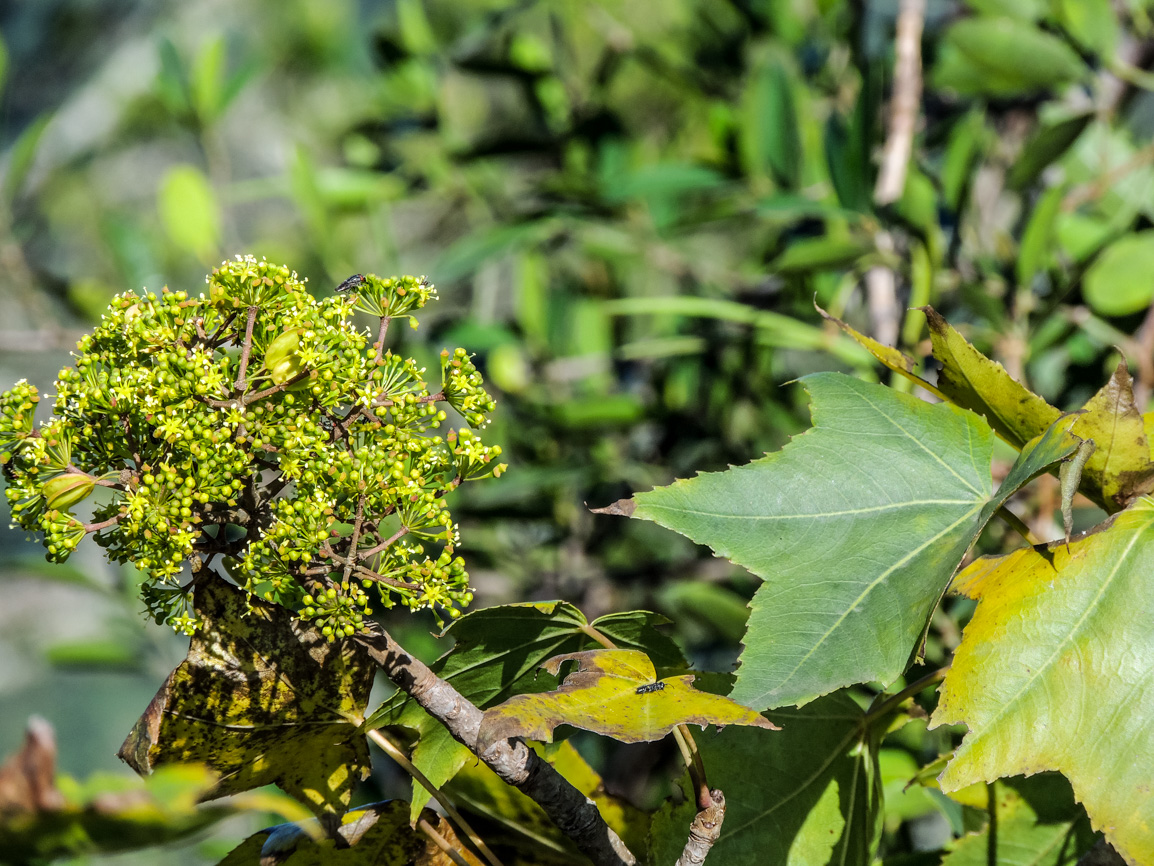
Seemannaralia gerrardii
There were many succulents on and under the rocks along the cliffs. Crassulaceae were well represented, amonst others Crassula obovata, Crassula orbiculata, Crassula perforata var brachypetala, and Crassula perforata var perforata, Cotyledon orbiculata and Cotyledon velutina and Kalanchoe rotundifolia.
Cotyledon velutina
Crassula orbicularis
We finally came across a plant which might be Caputia oribiensis but this awaits specialist confirmation. Apart from this find, the walk concluded on a high note and the last section of cliffs visited are in a much better condition with few if any alien invasives.

Update: 5 May 2016
The plant suspected to be our target species, Caputia oribiensis, unfortunately turned out to be an atypical Kleinia fulgens - so the search goes on!

Participants: Anne S, Dorothy M, Graham G, Kate G, Uschi T.


Friday, 22 April 2016

To the Western Heights for Ericas and Oleas

We had been asked to look out for flowering Erica cerinthoides var barbetona plants and also wanted to try to find ripe fruits on Olea capensis subsp. enervis, so we elected to go to the Western Heights area of the Umtamvuna NR where we knew both species could be found.

On the way we saw Erica aspalathifolia still flowering. While driving across the Western Heights towards Vulture Nek, we spotted some orchids and stopped to see what they were. These turned out to be Habenaria falcicornis - we saw a few more of these scattered through the grassland in the course of the day. Just before arriving at Iron Crown we found a few bright orange Erica cerinthoides in flower - it seems these are just starting to flower so there should be more in the weeks to come.

Habenaria falcicornis
Erica cerinthoides var barbetona
We took time to wander around the Iron Crown area - the views into the Umtamvuna gorge from the east are spectacular as the cliffs drop vertically almost to river level.

The cliffs east of Iron Crown - this close to the edge a steadying hand is needed
Looking down into the gorge with the Umtamvuna river below
Close to these cliffs we found a very early flowering Eulophia parviflora and a Searsia pondoensis also in flower.

Eulophia parviflora
Searsia pondoensis
On the cliff edge we found an Olea capensis subsp. enervis in flower, although the tree also had fruits. Other trees flowering nearby were Eugenia verdoorniae, Anastrabe integerrima and Maytenus acuminata.
Olea capensis subsp. enervis
We then left Iron Crown and headed towards the old Vulture Restaurant site - on the way we found Moraea spathulata, Rafnia elliptica and Pimpinella caffra in flower.

Moraea spathulata
Pimpinella caffra
Rafnia elliptica
On rocks under the forest canopy near the old Vulture Restaurant there were Stenoglottis fimbriata with fruits and some Peperomia retusa in flower. Under shrubs at the edge of the cliffs there were groups of Kalanchoe rotundifolia in flower.

Peperomia retusa
Kalanchoe rotundifolia
In the grassland we found a few unobtrusive Aloe myriacantha and a solitary Monsonia praemorsa with its delicate scrollwork on the outside of the petals and very hairy calyces.
 
Aloe myriacantha
Monsonia praemorsa


Participants: Anne S, Dorothy M, Graham G, Kate G, Maggie A, Uschi T.

A day for Nerines at Ngele

Having been alerted by DAFF official Mr. Roberston Madwe to the fact that the Nerines growing next to the N2 Highway had started flowering, we arranged a trip to assess the four populations we know in the Ngele area. One small population of N. appendiculata is close to the N2 - so close that the plants are often damaged by roadside brush-cutting activities. These plants were particularly robust as can be seen below.

Nerine appendiculata
We found a very early Cyrtanthus breviflorus flowering near these Nerines.

Cyrtanthus breviflorus
We then drove past a population of the much more threatened Nerine bowdenii subsp. bowdenii - this population is growing on the bank at the side of the N2 and it is too dangerous to stop here. A little further on we came to a much larger population of this species, although, as the plants grow in amongst rather tall woody shrubs, the size of the population is not amenable to counting.

Nerine bowdenii subsp. bowdenii
This is certainly the largest known population of this species.  Last year a search in previously known localities for the species in the Eastern Cape did not yield any plants, so Ngele may have the only populations of Nerine bowdenii subsp. bowdenii. 

Our last stop (delayed by an inopportune puncture on the way up) was on the plateau near Belfast Lookout where the small N. appendicluata population was also flowering well.

Participants: Anne S, Graham G, Kate G, Isabel J, Ruth C, Timo vd N, and Uschi T.


Saturday, 9 April 2016

Back to Umbumbazi after a long absence

Umbumbazi is a small Nature Reserve run by Ezemvelo KZN Wildlife and is situated about 7 kilometres due south of the Oribi Gorge Nature Reserve reception. As there have been disputes over land use issues with the local community we have stayed away, but yesterday we were asked to assist Dave and Yvette with the retrieval of several camera traps which Yvette has been using for a PhD research project. All the cameras had been deployed in forest patches to detect small mamals - this trip would give us the opportunity see what was flowering in the grasslands and forest patches while the cameras were being collected.

It seems that maintenance has been rather neglected as the access roads were almost hidden under shoulder-high grass. Unfortunately, we soon found out that the tick population was flourishing.

In the first forest patch we found Allophyllus dregeanus in flower and the fruits of a Dioscorea cotinifolia at the forest edge and deeper in the shade, some Isoglossa cooperii.
 
Allophyllus dregeanus
Dioscorea cotinifolia fruits

Isoglossa cooperii
On a grassy slope we came across Helichrysum decorum and a tangle of Macrotyloma axillare with its pink-tinged greeny-yellow flowers. In a nearby bush clump Kiggelaria africana had a few very late flowers as well as hosting caterpillars of the garden Acraea (Acraea horta) in various sizes, nicely timed to escape predation by intra-African migrant cuckoos.


Helichrysum decorum
Macrotyloma axilare
Kiggelaria africana (with Acraea horta caterpillar partially obscured)
The Trema orientalis displayed its ripening fruits to entice birds.

Trema orientalis
In a lower-lying grassland/wetland we found Syncolostemon densiflorus, Pycnostachys reticulata, Watsonia pillansii, Pachycarpus concolor and Schizoglossum atropurpureum subsp. virens in flower.
Syncolostemon densiflorus
Pycnostachys reticulata
Watsonia pillansii
Pachycarpus concolor
Participants: Anne S, Dave E-S, Graham G, Kate G, Uschi T, Yvette E-S