Thursday, 16 June 2016

Western Heights burn revisited

The burned area we visited on the 7th May (apparently this was an arson burn) had produced very little in the way of flowering species so we thought it might be worthwhile revisiting the area to see if anything more had since sprouted. It was a day after a cold front had passed through and it was overcast, windy and cold but undeterred, we headed across to the Western Heights and stopped where we had previously parked.

What a difference! The ground was covered in flowers - many of these species were flowering way earlier than normal but this was probably stimulated by the early burn and a little rain. With these riches in front of us it was difficult to wait for our tea addicts to get their fix. Soon we set off and species lists were being recorded and cameras were snapping.
Mervyn and Uschi deep in discussion amongst the flowers
The daisy family (Asteraceae) were the best represented with many Helichrysum species, two Afroaster species and several Berkheya, most numerous being Berkheya speciosa. The Helichrysum ecklonii were at their best with some of the new flowers bright pink.

Helichrysum ecklonii
It was interesting to see two species of Afroaster flowering in close proximity to each other; Afroaster hispida (previously called Aster bakerianus with hairy stalks) and A. serrulatus (previously called Aster harveyanus).

Afroaster hispida
Afroaster serrulatus
Interspersed amongst these were Acalypha peduncularis, Clutia monticola, Eriosema kraussianum, Commelina africana and Hebenstretia dura.

A bit further down the slope in a wetland area the Gladiolus longicollis were flowering well. It is interesting that many of these flowers sport double heads. Not far from these we found a number of spikes of Gladiolus wilsonii.

Gladiolus longicollis
Gladiolus wilsonii
Up tight under a rock outcrop we found several of what we prefer to call Merwilla kraussii as these are so different from M. plumbea (formerly Scilla natalensis). On the rocks above them we were very happy to find Utricularia sandersonii with their pale, delicate flowers.
Merwilla kraussii
Utricularia sandersonii
Also on the rocks we found the only orchid in flower today - a Polystachya pubescens.


Polystachya pubescens
Heading back up the slope we found some of the endemic Lotononis bachmannii in flower, as well as a few Graderia scabra.

Lotononis bachmannii 
Graderia scabra
 
Sometimes I think our outings require a health warning
Huddled in the lee of the rocks having lunch.
Despite the cold conditions, a most successful walk!

Participants: Anne S, Dorothy M, Graham G, Kate G, Mervyn T, Uschi T.


Sunday, 12 June 2016

A visit to Gogosa's forests and grassland


This Thursday's outing was moved to Friday to accommodate visitors from Durban -- Syd Ramdhani and his student Gracious from UKZN Westville came to see Memecylon in the field and Teddy Govender brought his plant knowledge to the party.  We entered the reserve at the northern gate, known as 'Gogosa' and despite the dry conditions, there were several plants in flower in the grassland, such as Dierama igneum, Eriosema kraussianum, Aspalathus gerrardii, Phylica natalensis and Wahlenbergia capillacea.  

Working our way along the forest margin,  we came across Psoralea glabra, Lotononis eriocarpa and Euryops laxus.  The forests along the small streams and gullies in this section of the reserve are different from those in the main Umtamvuna valley, which makes exploring them all the more interesting.    There were several Memecylon bachmannii and even one in fruit so that Gracious got a good feel for recognising her research subject in the field for future reference.  Peddiea africana flowered in abundance, along with Tricalysia capensis and Gerardina foliosa.
Clivia robusta
Peddiea africana
Graham, on the comeback trail, elected to stay out in the grassland where the going was a little more even and flat. A warm berg wind was blowing (presaging a cold front) but fortunately the humidity was low so the conditions were comfortable. 

There were Muraltia lancifolia and Agathosma ovata flowering amongst the grass and the Ctenium concinnum were showing their curly pigs' tails. He found a single Eulophia parviflora hiding in the grass. Despite this being our "quiet season" we ended up with quite an impressive list of species in flower.

Eulophia parviflora
Muraltia lancifolia

Ctrenium concinnum
View coastwards down the Umtamvuna River
View inland where the group explored the forest patches

Participants: Anne S, Gracious M, Graham G, Kate G, Mervyn T, Syd R, Terry G, Uschi T.

Thursday, 9 June 2016

Flowering now (June 2016)


Acalypha peduncularis
Afroaster hispida
Afroaster serrulatus
Aloe ferox
Aloe thraskii
Aristea ecklonii
Ascolepis capensis
Berkheya speciosa
Berkheya rhapontica
Callilepis laureola
Clutia monticola
Commelina africana
Dierama igneum
Diospyros scabrida
Eriosema kraussianum
Eulophia parviflora
Gladiolus longicollis
Gladiolus wilsonii
Graderia scabra
Halleria lucida
Hebenstretia dura
Helichrysum ecklonis
Helichrysum griseum
Helichrysum nudifolium var oxyphyllum
Helichrysum nudifolium var pilosellum
Helichrysum pallidum
Indigofera rubroglandulosa
Lotononis bachmannii
Merwilla kraussii
Muraltia lancifloia
Rafnia elliptica fruits
Ursinia tenuiloba

Monday, 6 June 2016

A search for members of the Coca family

We were joined by a student from the University of Pretoria, Sewes Alberts, and his dad Paul, with the objective of finding Erythroxylaceae species for his postgraduate research project. Sewes is investigating the chemical compounds, DNA and medicinal properties of Erythroxylum and Nectaropetalum. 
We started at Beacon Hill where we did not have to go far to find several Erythroxylum pictum and with many hands, the task of collecting leaves was completed quickly. 
 
Erythroxylum pictum fruit

The next destination was the Pont entrance to the reserve where we walked along the Fish Eagle trail that runs parallel to the Umtamvuna river. There are literally hundreds of Nectaropetalum zuluense along the trail but we could not find anything that matched the description of N. capense. There is some doubt as to whether these two are in fact separate species and we hope Sewes will be able to solve this problem for us with DNA work. 

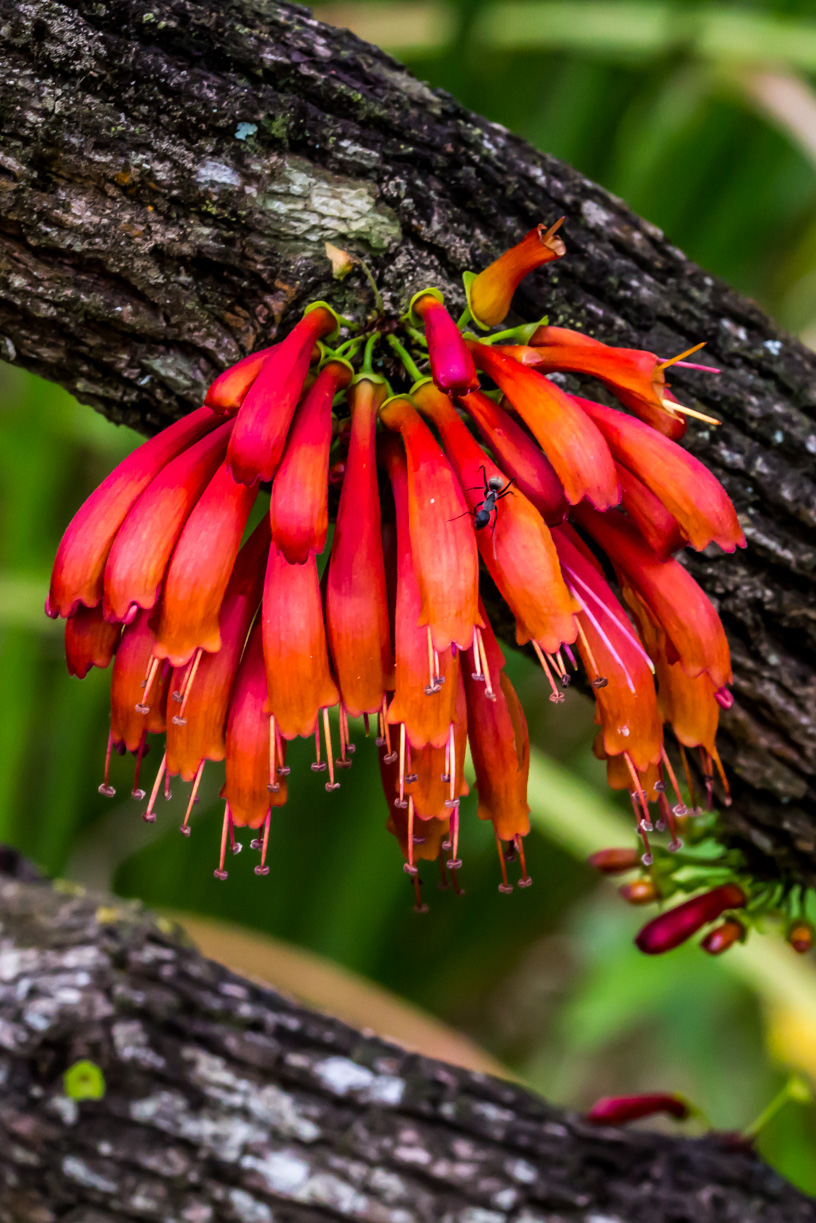
At this time of year and with very dry conditions, there was very little in flower but we did find Quisqualis parviflora and Canavallia bonariensis in the canopy and Hypoestes aristata, Dicliptera extenta and Desmodium repandum along the paths. 
 
Quisqualis parviflora

We enjoyed lunch in the forest shade while admiring the many magnificent old trees, some with spectacular buttresses. 

Leaving the Umtamvuna, the next stop was the Mpenjati reserve where we found Erythroxylum emarginatum along the trail on the south bank. Finding three of the four target species made for a good day in the field.


 Participants: Anne S, Dorothy M, Kate G, Mervyn T, Paul A, Sewes A, Uschi T.