Monday, 14 July 2025

Beacon Hill

A small but eager group gathered at Beacon Hill for a gentle meander into the Umtamvuna Nature Reserve. The stone path, winding its way down into the forest, offered a tranquil beginning to the day.

The reserve had recently experienced a controlled burn, and with the charred earth still fresh, we were delighted to find Cyrtanthus breviflorus already in flower. This remarkable fire lily is well known for its rapid response to fire—typically blooming just three days after a burn. Its delicate yellow trumpets stood out vividly against the blackened soil, a hopeful sign of renewal and resilience.

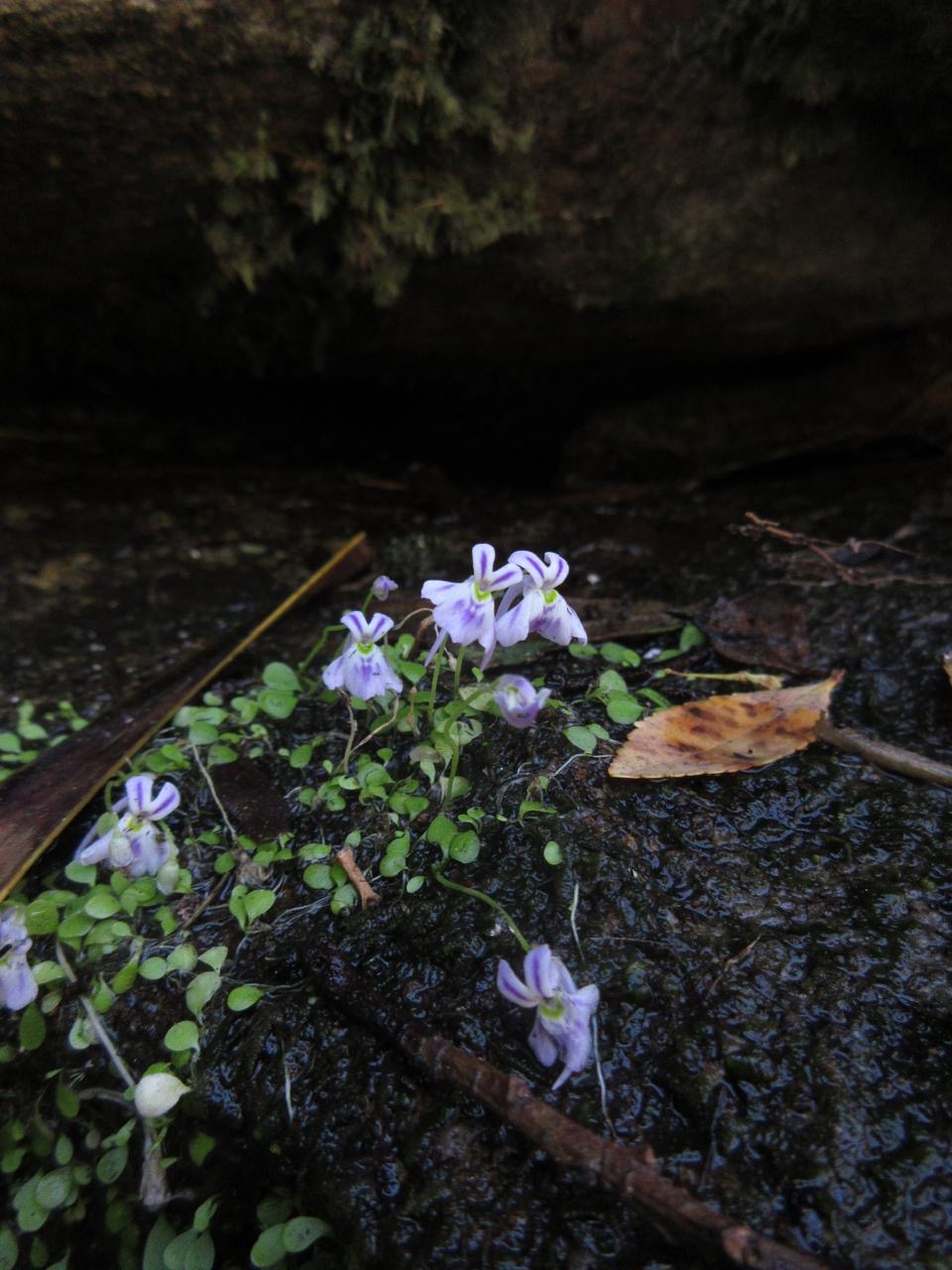
Following the course of a clear forest stream, we came across Persicaria decipiens in bloom, its soft pink flower spikes nodding gracefully above the water. On nearby wet rock faces, the tiny carnivorous Utricularia sandersonii revealed its charming, almost rabbit-eared flowers—a delight for those who know where to look.

The highlight of the morning was undoubtedly the discovery of Brunia trigyna, a species with a limited distribution and always an exciting find. Growing along the forest edge, the shrub was laden with buds, promising a dramatic floral display in the coming weeks. Encountering it at this early stage of flowering made for a particularly rewarding moment.

The day was both joyful and fulfilling, reminding us once again of the quiet magic found in these wild spaces—especially for those who take the time to look closely.

Brunia trigyna
BRUNIACEAE
Pondo Ghost-bush
Critically Endangered B1ab(v)+2ab(v); C2a(i); D
Photo credit:  Alf

Utricularia sandersonii 
LENTIBULARIACEAE
Bladderwort
South African endemic
Photo credit:  Alf


Persicaria decipiens
POLYGONACEAE
Photo credit:  Uschi

Cyrtanthus breviflorus
AMARYLLIDACEAE
Photo credit:  Alf


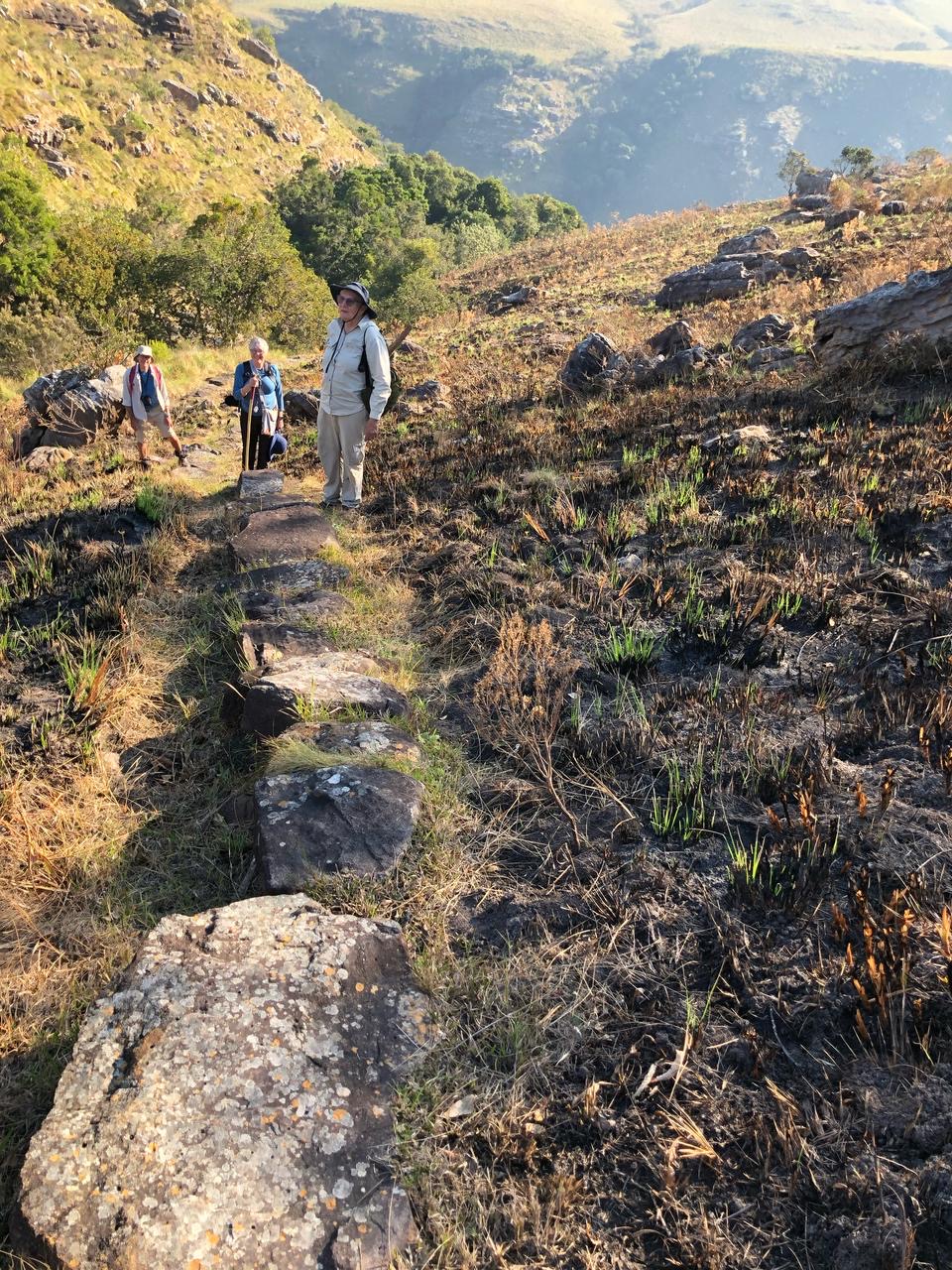
A happy Pondoland group.  Hilliary, Anne and Alf heading down to see the if the Brunia trigyna is flowering.  Photo credit:  Uschi

The old stone path that leads one down past Brunia trigyna and into the forest.
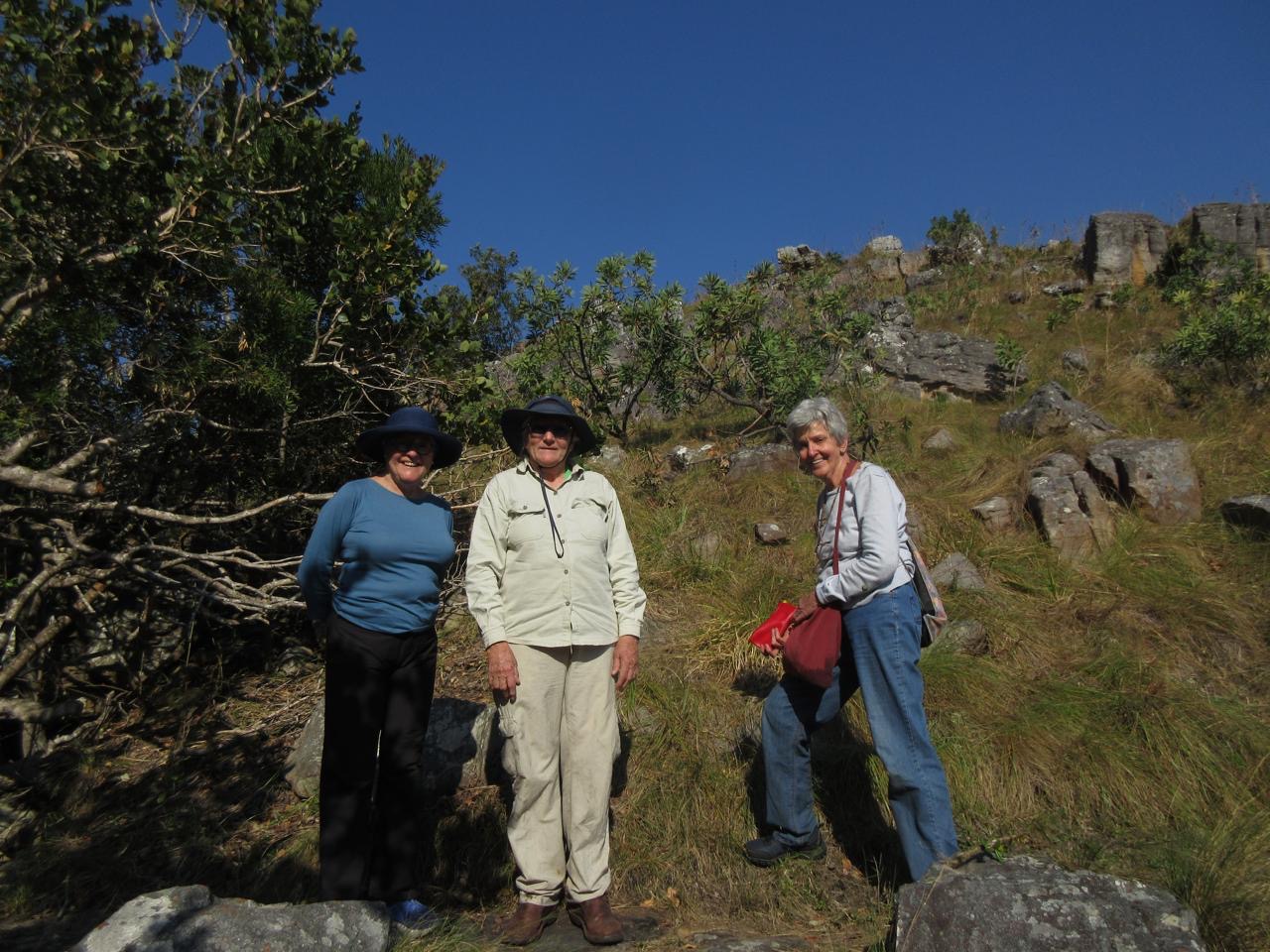
Alf, Hilliary and Anne.  Photo credit:  Uschi


Pondoland CREW
Hilliary Henderson, Anne Skelton, Ushchi Tercher and Alf Hayter

"To study a flower is to hold the entire ecosystem in your hand." Carl Linnaeus


Iron Crown

On this field day, the Pondoland CREW group convened at our usual meeting point on Beacon Hill. We were pleased to welcome Lulu and Maike, who joined us for the day’s survey. Lulu generously brought homemade lemon cordial, prepared from lemons from her tree in Gauteng—a thoughtful gesture warmly received by the group.

Our team proceeded in convoy, travelling cautiously through Western Heights, where cattle are unfortunately still present within the reserve. We made our way to the far end of the track, stopping at The Iron Crown, specifically to record Erica cerinthoides, which had been in flower for several weeks. Although past peak, we were fortunate to observe the final flush of its brilliant coral-red blooms, standing out vividly against the senescing grasses. This species, known for its fire-adapted ecology, remains visually striking even at the tail end of its flowering phase.

On the rocky outcrops near the cliff edge, we located Centella glabrata, nestled in crevices where moisture lingers slightly longer. Further into the grassland, the team encountered numerous individuals of Eulophia parviflora, flowering prolifically. The population included both long-spurred and short-spurred forms, and we made comparative notes on individuals bearing leaves versus those flowering while still leafless—a known trait within this genus where flowering often precedes foliage emergence.

The survey pace was measured, allowing for detailed observations. Among the rocky patches, Burchellia bubalina was recorded in its uncommon red-flowered form. This species is typically orange-flowered, and we reflected on a rare yellow-flowered form previously observed in the region. The specimen observed was robust, demonstrating the species' well-known hardiness.

In the dappled shade beneath isolated trees, we recorded several moisture-stressed individuals, including Haemanthus albiflos, Crassula sarmentosa var. integrifolia, and Crassula perfoliata var. heterotricha. All showed signs of drought stress, indicative of the current dry conditions and the urgent need for seasonal rainfall.

As the group returned to the vehicles, a final highlight emerged. Ushi observed a flowering Moraea, and closer inspection confirmed it as Moraea elliotii, identified by its characteristic long basal leaf. True to its species behaviour, the flower had opened in the early afternoon—M. elliotii is known for its precise phenology, with blooms reliably appearing at approximately 14:00, and each lasting only for the duration of a single day.


Erica cerinthoides
ERICACEAE


Lulu and her daughter Maike.

Centella glabrata 
APIACEAE

"Where there's smoke, there's fire."


The valley below The Iron Crown

Burchellia bubalina
RUBIACEAE

Haemanthus albiflos
AMARYLLIDACEAE


Crassula sarmentosa var. integrifolia
CRASSULACEAE
South African endemic

Crassula perfoliata var. heterotricha
CRASSULACEAE
South African endemic

Moraea elliotii is a geophytic species belonging to the family Iridaceae. It survives extended dry periods by storing energy in an underground corm and emerges to flower only when environmental conditions—typically after rain—are favourable. The species is notable for its phenological precision: the delicate, powder-blue flowers open consistently in the early afternoon, around 2 o’clock, and each bloom lasts for just a single day.

The plant bears narrow, grass-like leaves that blend effectively into the surrounding vegetation, offering natural camouflage from herbivores. This morphological adaptation, combined with its underground storage organ, allows it to tolerate both grazing and seasonal fires. Moraea elliotii is frequently observed in recently burned grasslands, where post-fire nutrient availability and reduced competition provide ideal conditions for flowering and regeneration. 

Ushi and Alf looking at Moraea elliotii in the grasslands.

The long leaf coming from Moraea elliotii

Moraea elliotii
IRIDACEAE

Eulophia parviflora – The name says it all: “parvi” means small, and “flora” refers to its flowers. These delicate blooms come in pale shades of green, yellow, or sometimes with purple tones. The species often flowers in response to fire or the first rains.

There are two notable spur variations. Some plants bear a long, narrow spur that extends behind the flower—likely an adaptation for long-tongued insect pollinators. Others have a much shorter spur, which could reflect natural variation, environmental adaptation, or reduced reliance on specific pollinators. Interestingly, some populations or individuals produce sterile flowers, which may not set seed but still play a role in attracting pollinators to fertile plants nearby.

Like many Eulophia species, this orchid often flowers before the leaves emerge. You may spot the flowering spikes rising straight from bare ground, seemingly leafless. Only later do narrow or linear leaves emerge from the underground tuber. In some cases, the plant remains leafless at flowering time, or shows only rudimentary leaf growth.


Eulophia parviflora
ORCHIDACEAE

Taking a close look at the spurs growing on Eulophia parviflora


Polystachya pubescens 
ORCHIDACEAE

Ushi's Eskom-se Push socks! 


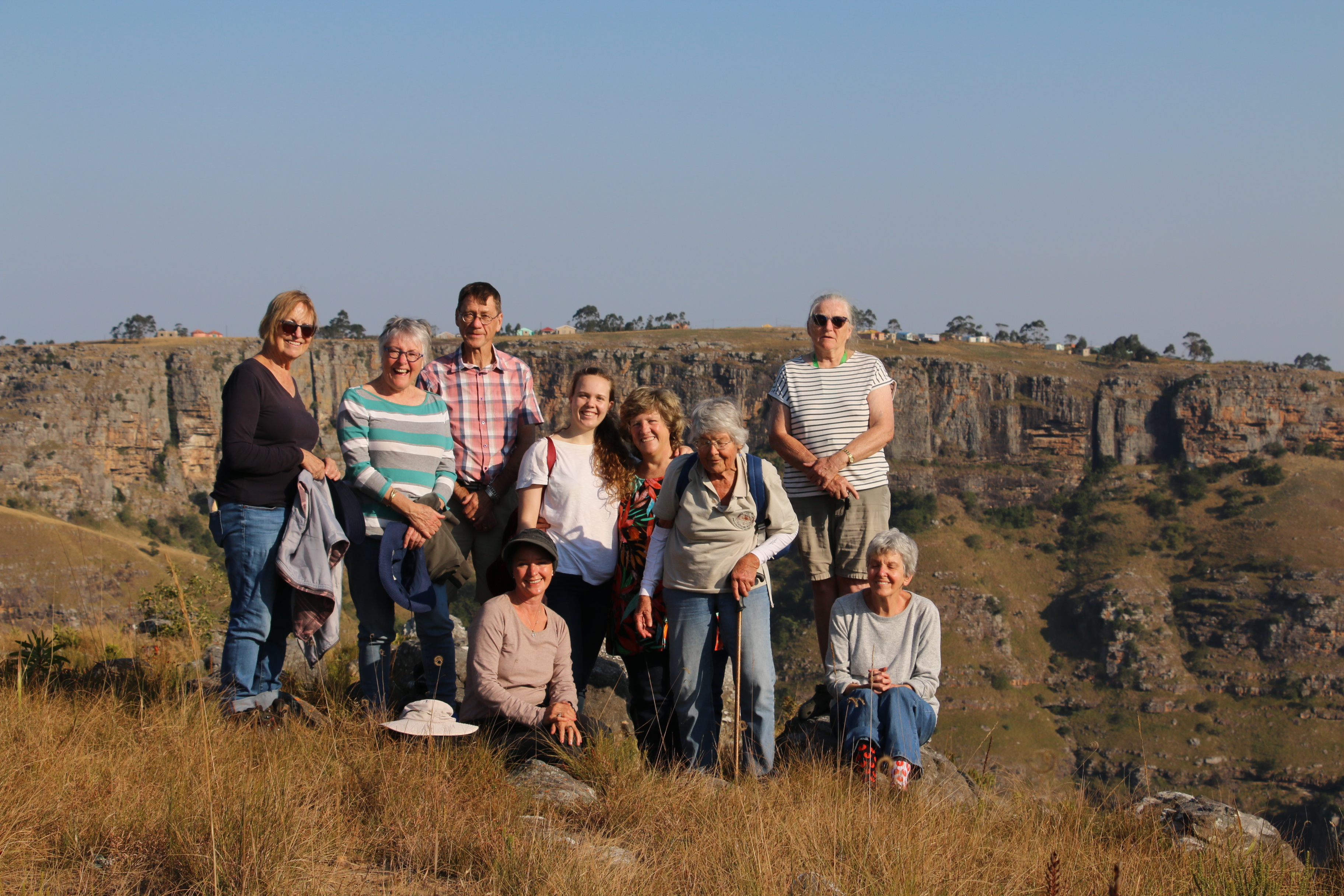
Pondoland CREW
Maggie Abbott, Hilliary Henderson, Alf Hayter
Guests:  Maike and Lulu Granig
Gail Bowers-Winters, Dorothy McIntyre, Anne Skelton and Uschi Tercher.

“We still do not know one thousandth of one percent of what nature has revealed to us.” 

                                                                                                                  - Albert Einstein


Wednesday, 25 June 2025

Smedmore area

We met at our usual gathering point, counted heads, and sardined ourselves into vehicles, off to explore the pristine grasslands and forest margins once more. Plumes of dust billowed up behind us like sandy clouds in the sky—a mingling of earth and air, an amber veil of brown and white—before our convoy came to a gritty halt.

Anne, our human GPS with the instincts of a migrating swallow, was not with us that day. So we relied on intuition, following our gut to lead us where we hoped to find ourselves botanising: a place where Clivia robusta grows waist-high on the edge of a sheer cliff.

We had discovered this colony of Clivia the year before, and returned now with the hope of catching them in flower. But again, we were just too late. Still, we were fortunate—clusters of glossy green seeds hung like ripening grapes, and we marvelled at nature’s quiet promise of renewal.


Clivia robusta
AMARYLLIDACEAE
Vulnerable A2cd; B1ab(ii,iii,v)
South African endemic

Everything seemed more beautiful than usual. The air was crisp, with not a breath of wind. Birds sang joyfully. The soft, buttery-yellow buds of Diospyros lycioides hung like miniature bells, and the leaves, velvety to the touch, added to the day's magic.

Diospyros villosa var. villosa
EBENACEAE
Hairy Star-apple 
South African endemic

Tracy and Uschi looking closely at flowers on a tree.

Rapanea melanophloeos
MYRSINACEAE
Cape Beech


Erythroxylum pictum 
ERYTHROXYLACEAE
Blue-leaved Coca-tree

At the stream, water burbled and danced through rocks before spilling over the edge, cascading in silver threads all the way down to the Mtamvuna River. Along the forest margin, Hypoestes forskaolii and Phaulopsis imbricata were in flower, brushing colour onto the understory like watercolour strokes.  


Hypoestes forskaolii 
ACANTHACEAE

Issoglossa sp.

Phaulopsis imbricata
ACANTHACEAE

Xysmalobium involucratum
APOCYNACEAE

Never had I remembered Halleria lucida looking so beautiful. Tubes of fiery orange-red flowers hung directly off the trunk and branches, like flickering flames. It was as if the tree itself had caught fire, not in destruction, but in celebration.

Halleria lucida
STILBACEAE
Wild Fuschia


Burchellia bubalina
RUBIACEAE
Wild Pomegranate 

We sat quietly on the forest floor, nestled among the long, arching leaves of Clivia robusta, some well over a metre in length. There was a stillness there—an otherworldly calm—as if, with enough silence and patience, we might catch a glimpse of elves or fairies slipping through the leaf litter.

Perched on the edge of a rock under the leafy canopy, we looked down. It must have been at least 350 metres to the forest floor. From there, we had a bird’s-eye view of the tree canopy. We spotted Cussonia and Bersama lucens in seed, and Rhoicissus digitata winding its five-fingered leaves skyward like green stars climbing into the light.


Bersama lucens
MELIANTHACEAE
Glossy White Ash

Cussonia sp.
ARALIACEAE

Rhoicissus digitata
VITACEAE

A gall on the Rhoicissus digitata

In this enchanted forest, Hyperacanthus amoenus grows—a species said to give off an intoxicating scent when in flower. One can only imagine the perfume drifting through the trees.

Zanthoxylum capense, commonly known as the knobwood, is a small tree or shrub distinguished by its spiny branches and citrus-scented leaves when crushed. With age, the lower spines often lose their rigidity, giving older specimens a softened appearance. This species is well known in traditional medicine for its wide range of uses. Crushed leaves are used to reduce fever, while various parts of the plant are employed as a remedy for snake bites and toothaches. Twigs are commonly used as natural toothbrushes — they contain antimicrobial compounds that help reduce plaque and promote oral hygiene. Z. capense is a remarkable example of a multipurpose medicinal plant found in southern Africa. - Some of the botanical details mentioned here are adapted from “Pooleys Trees of Eastern South Africa – A compete guide” by Richard Boon.

Zanthoxylum capense 
RUTACEAE
Wag-'n-bietjie

As we meandered back, the golden afternoon light caught the pink flowering stems of Agathosma ovata. On the hillside, Syzygium cordata's stood like sentinels, full of character, gnarled and proud. We searched for Habenaria filicornis, the delicate green orchid we had once seen in this very grassland—its flowers like tiny green people dancing in the wind. But this time, we may have just missed them.

Still, we carried the magic of the day with us—reunited with full hearts, bringing back our “takkies” from the forest, a bit like show-and-tell. Nearing the exit, we stopped to admire a Fish Eagle and four Crowned Cranes, perched regally on the ghostly trunks of dead Eucalyptus. It was a truly magical day.


Dalechampia capensis
EUPHORBIACEAE

A ghost tree in the forest.

Eugenia verdoorniae
MYRTACEAE
Small-leaved Myrtle
Near Threatened B1ab(iii,v)
South African endemic

Agathosma ovata
RUTACEAE


Senecio helminthioides
ASTERACEAE

Tracy, Alf and Sarel.


Wahlenbergia capillacea  subsp. capillacea
CAMPANULACEAE
Photo credit:  Dorothy


Takkies – where botany meets brain-teaser.


Pondoland CREW
Back: G.B-W, M.A, S.H, S.C, D.M, U.T, T.T & A.H.

A special thanks to our teachers, who so freely share their botanical knowledge and guide us with patience and passion.

“I took a walk in the woods and came out taller than the trees.” – Henry David Thoreau