Our intention was to visit Manilkara Meander in the Umtamvuna Nature Reserve but when we reached the border of the reserve, we found a new fence with a locked gate in our way. As the farmer was in Port Edward at the time, we decided to visit Smedmore forest instead.
Hopping around to avoid the very active Pugnatious Ants, we set off to walk along the cliffs, heading for Atalaya Pass. This is the route we used previously to exit the forest before a fallen tree blocked the path about four years ago and we have not been able to use that path since then.
As we started walking we found a few Lotononis eriocarpa flowering together with a small clump of Leonotis leonurus. On the forest fringe we found Cryptocarya wyliei in fruit. Also on the edge of the forest we found Nuxia floribunda full of buds and a single Solanum giganteum with a small cluster of buds and some very young fruits. A Diospyros villosus showed off a fruit on the verge of splitting open. Hanging down from some of the taller trees, Rhoicissus tomentosa displayed some ripening fruits.
 |
| Lotononis eriocarpa |
 |
| Leonotis leonurus |
 |
| Cryptocarya wyliei |
 |
| Nuxia floribunda |
 |
| Solanum giganteum fruits |
 |
| Diospyros villosus fruit |
 |
| Rhoicissus tomentosa |
A bit further along we came across a tall
Faurea macnaughtonii with several old fruit clusters. Nearby was a
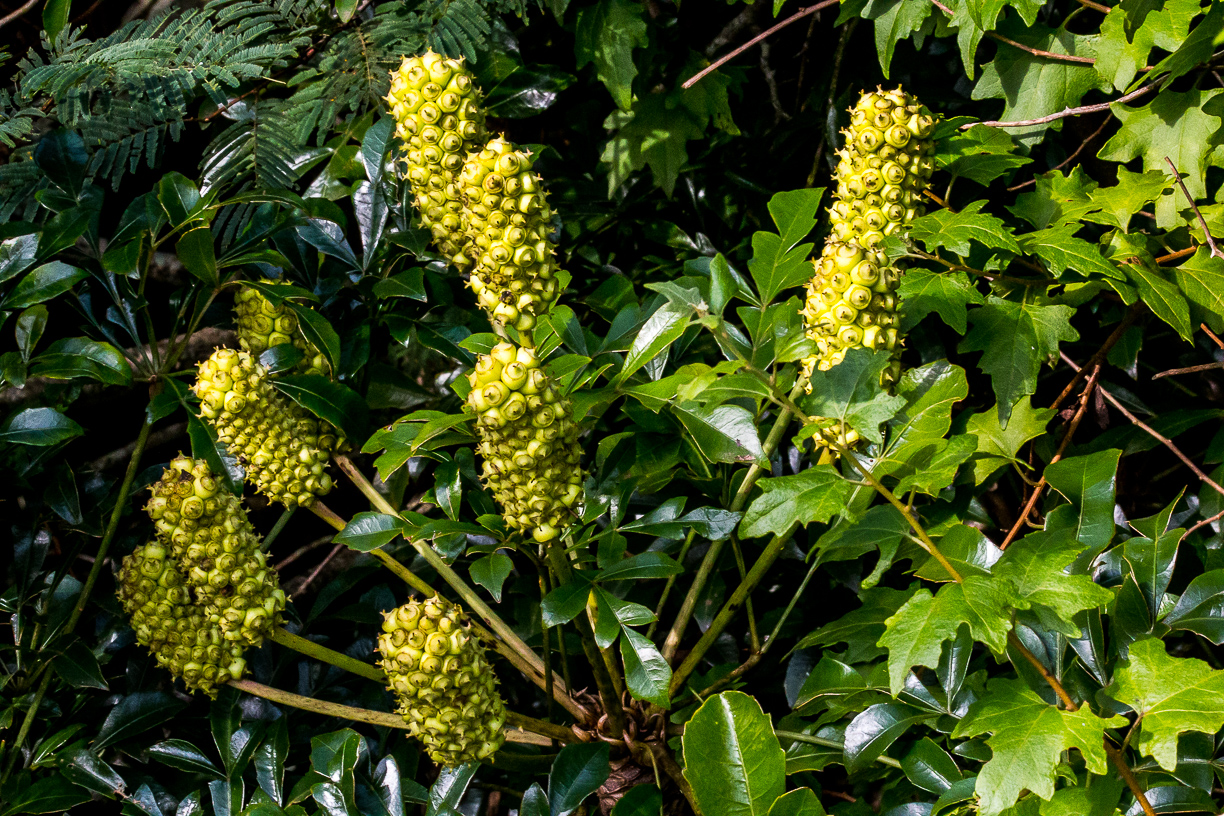
Bersama swinnyi boasting a good crop of terminal fruits. Draped over one of the forest edge trees was
Petopentia natalensis with a large, paired follicle. In the adjacent grassland we found an
Asclepias praemorsa.
 |
| Faurea macnughtonii |
 |
| Petopentia natalensis |
 |
| Asclepias praemorsa |
 |
| Bersama swinnyi |
A bit further along the cliff edge we found a
Combretum kraussii with a really showy crop of red fruits and not far away was a
Combretum edwardsii with far less obtruive fruits
. Looking over the edge of the cliff, we could see the top of a large
Podocarpus falcatus with blue-green round fruits dotted around the canopy.
 |
| Combretum kraussii |
 |
| Combretum edwardsii |
 |
| Podocarpus falcatus fruits |
Further along we found a few Dimorphotheca fruticosa flowers and a small Rhynchocalyx lawsonoides with some reachable open flowers. Surprisingly, a stubby Vangueria infausta had some ripe fruits - normally baboons get to eat these first.
 |
| Dimorphotheca fruticosa |
 |
| Rhynchocalyx lawsonoides |
 |
| Vangueria infausta |
We reached the top of Aatalaya Pass and descended into the welcome shade and coolness. We scrambled all the way to the bottom of the slope only to find that the path had been swallowed up by the forest. It would take a major effort to open the path again so I guess that path has gone for good. We enjoyed our lunch in the deep shade accompanied by several
Stangeria eriopus with leaves in excess of two meters long.
After trudging back up the steep climb we followed another path to a view site where we could look down on the Umtamvuna River. From these rocks we could see fruits at the top of a Commiphora harveyi and behind us was a very large specimen of the same species. This one was an eminently huggable tree!
 |
| The view into the Umtamvuna River gorge |
 |
| Commiphora harveyi |
 |
| An eminently huggable tree |
On the return route we skirted the forested edge along a stream where we saw
Dalechampia capensis and a
Garcinia gerrardii sorely afflicted with
Viscum obscurum. Just before we reached the vehicle we found a small
Volkameria glabra in flower.
 |
| Dalechmpia capensis |
 |
| Viscum obscurum |
 |
| Volkameria glabra |
Participants: Anne S, Gail B-W, Graham G, Maggie A, Tracy T.